
- Resource Library
- Science
- Earth & Space Science
- Plate Boundaries
- Unit 6 Part 3: Plate Boundaries And Faults
Unit 6 Part 3: Plate Boundaries and Faults

Presentation
•
Science
•
9th - 12th Grade
•
Medium
+15
Standards-aligned

Abby Fancsali
Used 5+ times
FREE Resource
20 Slides • 17 Questions
1
Science Root of the Day:
DO NOW: Write what you think the example words mean in your lab manual.
Extra Credit: Find three additional words that use this root and write them and their definition in your lab manual (6 Points Max)

2
Plate Boundaries and Faults

3
Multiple Choice
Which theory describes the motion of and force driving Earth's plates?
The First law of Motion
The Third Law of Motion
Continental Drift
Plate Tectonics
4
Multiple Choice
Where does Subduction Occur?
Along the middle of some Ocean Floors
Down the middle of Mountain Ranges
On Continents
At Deep-Ocean trenches
5
Multiple Choice
Which process adds more crust to the ocean floor
Suction
Sea-floor Spreading
Subduction
Magnetic Stripe
6

Lesson Objectives
Summarize the characteristics of divergent, convergent, and transform plate boundaries
Describe how the crust is shaped by plate movement
7
Introduction
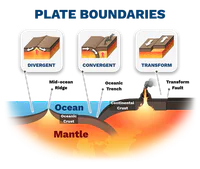
Tectonic plates meet at plate boundaries
Many types of geologic activities occur at these boundaries
Earthquakes
Mountain Building
Volcanoes
Three types of plate boundaries exist
Divergent
Convergent
Transform
8
Divergent Boundaries
Plates are pulled apart from each other
Magma from the Earth's mantle erupts to the surface
When Plates move away, they can create massive cracks in the crust
When underwater, mid-ocean ridges form
When on land a deep rift valley forms

9
Convergent Boundaries
Plates collide together
the denser plate sinks while the less dense plate rises
Oceanic crust more dense and it sinks to the mantle
Continental crust raises up and forms mountains
When plates with the same density collide, the crust squeezes into high mountains

10
Transform Boundaries
Plates slide past each other in opposite directions
two jagged edges can get "caught" on each other and lock in place together
eventually enough force will break the two plates apart
Crust is neither created or destroyed
Mainly where Earthquakes occur
The San Andreas Fault

11
Multiple Choice
Type of plate boundary that causes the lithospheric plates to be pulled apart
Divergent
Convergent
Transform
12
Multiple Choice
Type of plate boundary that causes the lithospheric plates to move horizontally past each other
Divergent
Transform
Compression
Convergent
13
Multiple Choice
Type of plate boundary that causes the lithospheric plates to move towards each other
Divergent
Transform
Convergent
14
How Does Stress change the Earth's Crust?
The movement of Earth's plates creates forces that can bend and fold rocks
Stress: a force that acts on rock to change its shape or volume
Increases with Force
Adds Energy to Rock, which is stored until the Rock breaks
Three types of stress in the Earth change the shape of rock over millions of years

15
Tension
Stress force that pulls the crust of the Earth and thins Rock in the middle
Occurs when two plates pull apart

16
Compression
Stress force that squeezes rock until it folds or breaks
Occurs when two plates come together and push into each other

17
Shearing
Stress force that pushes a mass of Rock in two opposite directions
Can cause Rocks to break or slip apart
changes the shape of the rock
Occurs when two plates slide against each other

18
Match
Match the following types of stress with how they move
Tension
Compression
Shearing
Two Plates Pulling Apart
Two Plates Coming Together
Two Plates Slide against Each Other
Two Plates Pulling Apart
Two Plates Coming Together
Two Plates Slide against Each Other
19
How do Faults Form?
Most Faults occur along plate boundaries where the forces of plate motion push/pull the crust so much it breaks
When enough stress builds up inside a rock, it will break & create a fault
Three types of Faults
Normal
Reverse
Strike-slip
20
Normal Faults
The Fault cuts through rock at an angle so one block of rock sits over the fault & the other sits under the fault
Hanging Wall: the rock over the fault in a normal fault
Foot Wall: The Rock that lies under the fault
When movement occurs the hanging wall slips downwards
Occur where tension pulls rock apart

21
Reverse Faults
Has the same structure as a normal fault, but moves in the opposite directions
Hang wall Moves up, Foot wall moves down
Form in areas of compression in the crust

22
Strike-Slip Faults
Formed by Shearing
Rocks slide past each other sideways, with little up or down motion
When forms the boundary between two plates, it is called a Transform Boundary
23
Multiple Choice
When two plates move away from each other ________________ faults are created.
Normal
Reverse
Strike-Slip
24
Multiple Choice
Stress is a(n) ____________ that acts on rock to change its shape or volume.
Force
Power
Scale
Epicenter
25
Match
Match the faults to their descriptions
Normal Fault
Reverse Faults
Slip-Strike Fault
Hanging Wall Slides down when tension pulls rocks apart
Hanging Wall Slides up when plates push against each other
Rocks on either side of a fault slid against each other
Hanging Wall Slides down when tension pulls rocks apart
Hanging Wall Slides up when plates push against each other
Rocks on either side of a fault slid against each other
26
Multiple Choice
The Stress Force that pulls on the crust and thins the rock in the middle is
Shearing
Compression
Tension
Uplifting
27
Multiple Choice
The Stress Force that squeezes a rock until it folds or breaks is
Shearing
Compression
Tension
Uplifting
28
Multiple Choice
A fault in which the rocks on either side of the fault move sideways past each other is a __________
Slip-Strike Fault
Normal Fault
Hanging Fault
Reverse Fault
29
How Does Plate Movement Create New Landforms
Changes in the crust occur extremely slowly and are not easy to observe
Over millions of years, the forces of plate movement can change a flat plain into different features
anticlines
synclines
folded mountains
fault-block mountains
plateaus
30
Folding of the Earth's Crust
Folds: bends in rock that form when compression shortens and thickens Earth's Crust
When the crusts fold, rocks bend without breaking
a fold can vary in width

31
Anticlines and Synclines
Anticline: an upward bend in a rock
Syncline: A downward bend in a rock
Both Form in areas of compression in the crust
anticlines and synclines form when rocks fold over from compression

32
Stretching the Earth's Crust
Tension can stretch the Crust and leave Valleys surrounded by high elevations
Fault-Block Mountains: Mountains formed by tension

33
Uplifting the Earth's Crust
Plateaus: a large area of flat land elevated high above sea level
has many different flat layers
Occur when forces in the crust push up large flat pieces of Rock

34
Multiple Choice
Tension can cause the formation of Mountains and ________
Plateaus
Valleys
Anticlines
Sinclines
35
Multiple Choice
Normal faults occur when two plates ________
Come together
Pull Apart
Slide Against Each Other
36
Multiple Select
Mark all Correct Answers: Compression Causes the Formation of
Anticlines
Synclines
Plateaus
Valleys
37
Multiple Choice
A large Flat area of Land elevated High above Sea level is a(n)
Anticlines
Synclines
Plateaus
Valleys
Science Root of the Day:
DO NOW: Write what you think the example words mean in your lab manual.
Extra Credit: Find three additional words that use this root and write them and their definition in your lab manual (6 Points Max)
Show answer
Auto Play
Slide 1 / 37
SLIDE
Similar Resources on Wayground

36 questions
Cell Terms Part 3
Lesson
•
9th - 11th Grade
31 questions
Unit 4 - Axial Skeleton, Part 2 - The Vertebral Column
Lesson
•
9th - 12th Grade
32 questions
Air Masses and Fronts
Lesson
•
9th - 12th Grade
34 questions
Solving Radical Equations
Lesson
•
9th - 12th Grade
34 questions
Macromolecules
Lesson
•
9th - 12th Grade
32 questions
P-Wave S-Wave Travel Time
Lesson
•
9th - 12th Grade
31 questions
DNA Profiling
Lesson
•
9th - 12th Grade
Popular Resources on Wayground
10 questions
5.P.1.3 Distance/Time Graphs

Quiz
•
5th Grade
10 questions
Fire Drill
Quiz
•
2nd - 5th Grade
20 questions
Equivalent Fractions
Quiz
•
3rd Grade
15 questions
Hargrett House Quiz: Community & Service
Quiz
•
5th Grade
20 questions
Main Idea and Details
Quiz
•
5th Grade
20 questions
Context Clues
Quiz
•
6th Grade
20 questions
Inferences
Quiz
•
4th Grade
15 questions
Equivalent Fractions
Quiz
•
4th Grade
Discover more resources for Science
10 questions
Exploring the Layers of the Earth

Interactive video
•
6th - 10th Grade
25 questions
Naming Ionic and Covalent Compounds
Quiz
•
9th Grade
20 questions
Balancing Chemical Equations
Quiz
•
9th Grade
35 questions
DNA Structure and Replication
Quiz
•
10th Grade
20 questions
Non-Mendelian Genetics
Quiz
•
9th Grade
10 questions
Exploring the Dynamics of Ocean Currents
Interactive video
•
6th - 10th Grade
20 questions
The Cell Cycle and Mitosis
Quiz
•
9th Grade
15 questions
Genetics- Punnett Squares
Quiz
•
9th Grade