
Search Header Logo
7.1 How Organisms get Cellular Energy

7.1 How Organisms get Cellular Energy

Assessment

Presentation

Science

11th Grade

Practice Problem

Easy

NGSS
MS-ESS1-1, MS-ESS2-4, MS-PS1-1

+9

Standards-aligned

Created by

Lauren Shoemaker

Used 4+ times

FREE Resource

12 Slides • 5 Questions

1

7.1 Energy, Work, and Biology

2

Open Ended

What is energy? Can it be created?

3

How Organisms Obtain Energy
Copyright © McGraw-Hill Education

Transformation of Energy

  • Cellular processes require energy – the ability to do work.

  • Thermodynamics is the study of the flow and transformation of energy in the
    universe.

media

4

Energy and Work

  • One of the three fundamental components of the universe

    • Matter, Energy, and Intelligence

  • Energy is the thing that holds everything together and enabled most processes to function

5

Transformation of Energy

Laws of thermodynamics

  • First law—the law of conservation of energy: energy can be converted from one
    form to another, but it cannot be created nor destroyed.

  • Second law: energy cannot be converted without the loss of usable energy,
    that is, entropy—disorder or unusable energy—increases.

6

media

How Organisms Obtain Energy
Copyright © McGraw-Hill Education

Transformation of Energy

Autotrophs and Heterotrophs

  • Directly or indirectly, nearly all the energy for life comes from the Sun.

  • Autotrophs make their own food, either with energy from the sun or from
    inorganic substances.

  • Heterotrophs ingest other organisms to obtain energy.

7

Metabolism

  • All of the chemical reactions in a cell are referred to as the cell’s metabolism.

  • A series of chemical reactions in which the product of one is the substrate for the next is called a metabolic pathway.

    • Catabolic pathways release energy by breaking down larger molecules.

    • Anabolic pathways use energy to build larger molecules.

​Chemical Equation:
Reactant + Reactant -> Product

8

Drag and Drop

2​
+
=​
Drag these tiles and drop them in the correct blank above
O
H
H2O

9

Metabolism

Oxidation-Reduction Reactions

  • A Redox Reaction is when electrons are transferred from one reactant to another

  • Atoms that gain an electrons are reduced, Atoms that lose an electrons are oxidized

10

Metabolism

Hydrolysis Reactions Hydro-: Water -lysis: To break

  • Water serves as a reactant that slices another molecule in two

media

11

Fill in the Blank

Hydro means

12

Fill in the Blank

-Lysis means

13

media

How Organisms Obtain Energy
Copyright © McGraw-Hill Education

Metabolism

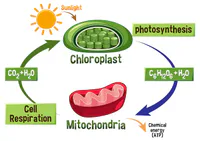
Photosynthesis – anabolic pathway in which light energy from the Sun is
converted to chemical energy for use by the cell

Cellular respiration – catabolic pathway in which organic molecules are broken
down to release energy for use by the cell

14

Open Ended

What do you think makes Photosynthesis anabolic and cellular respiration catabolic? Explain

15

media

How Organisms Obtain Energy
Copyright © McGraw-Hill Education

ATP: The Unit of Cellular Energy

  • In living things, chemical energy is stored in biological molecules.

  • Adenosine triphosphate (ATP) is the most important biological molecule that provides chemical energy.

  • What type of reaction is this Redox or Hydrolysis?

16

media

How Organisms Obtain Energy
Copyright © McGraw-Hill Education

ATP: The Unit of Cellular Energy

ATP structure

  • Most abundant energy-carrier in cells

  • Nucleotide made of an adenine base, a ribose sugar, and three phosphate
    groups

​Phosphate is denoted
as Pi

17

media

ATP: The Unit of Cellular Energy

ATP function

  • Releases energy when the bond between the second and third phosphate
    groups is broken.

    • This is the highest energy bond

  • Transforms into a molecule called adenosine diphosphate (ADP) and a free phosphate group.

  • Releases Heat, exothermic,

7.1 Energy, Work, and Biology

Show answer

Auto Play

Slide 1 / 17

SLIDE
