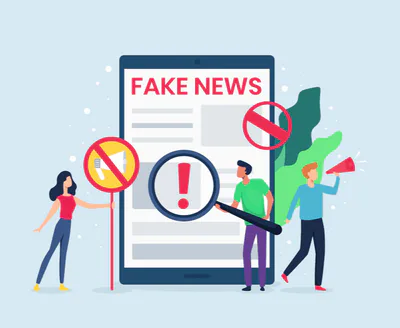
The Dark Side of Social Media - Part 1
Presentation
•
Other
•
9th - 12th Grade
•
Medium
Chad Hensley
Used 7+ times
FREE Resource
11 Slides • 10 Questions
1

Digital Citizenship Part 2:
The Dark Side of Social Media -
Falling for Social Media Algorithms, Filter Bubbles, and Misinformation.
2
Multiple Choice
How much time do you think the average person spends on social media each day?
Under one hour
About one and a half hours
About two and a half hours
Over three hours
3
While 2.5 hours a day doesn't sound like much, it equates to a little over a month each year that we spend on social media.
Because of its interactive nature, it is how most of us chat with friends, entertain ourselves, learn new things, and get our news of the world.
But can we always trust what our social media feed sends to us?
The Social Dilemma
4
Social Media Algorithms, Filter Bubbles, and Echo Chambers
Take a moment to watch the video on the next slide, and as you do, ask yourself:
How do social media ALGORITHMS work?
What is a FILTER BUBBLE?
How can I tell if my feed is leading me into a FILTER BUBBLE?
What can I do to guard against ECHO CHAMBERS?
5
6
Time for a few QUIZ QUESTIONS!!!
7
Multiple Choice
Fill in the Blank:
While they help us link with information that we are interested in, SOCIAL MEDIA ALGORITHMS can cause us to fall into ________, which lead us to becoming only partially informed on important topics.
Filter Bubbles
News Feeds
Video Loops
Time Warps
8
Dropdown
9
Multiple Choice
Which of the following is NOT a way that you can ensure that your social media feed does not turn into a FILTER BUBBLE or ECHO CHAMBER?
Actively search for information that might counter your beliefs
Read and react to posts that challenge your beliefs
Make harsh, negative comments on posts that go against your beliefs
Look for sources of information that provide multiple perspectives
10
Along with falling into a "FILTER BUBBLE," we also need to pay close attention to the TYPE of information that we are taking in or sending out.
Oftentimes, people believe or share MISINFORMATION because it looks like it might be credible.
The Dangers of Misinformation:
11
Incorrect information that is spread WITHOUT the intent to deceive others
Types of "FAKE NEWS"
MISINFORMATION
DISINFORMATION
Satire
Incorrect information that is spread WITH the intent to deceive others
Incorrect information that is spread WITH the intent to ENTERTAIN others
12
Oftentimes, people do not even realize they are spreading "fake news," largely because they do not really check to see if what they are sharing is SATIRE (funny) or DISINFORMATION (created maliciously).
"FAKE NEWS"
13
Take a moment to watch the short video on the next slide and as you do, ask yourself:
So how do we identify MISINFORMATION?
How can I avoid spreading misinformation?
How can I tell if someone I know is spreading misinformation?
What should I do if I find misinformation that is being shared?
14
15
QUIZ TIME, LITTLE HOMIES!!!
16
Multiple Choice
Silly or funny fake news articles that make fun of real news stories or people is called:
Clickbait
Disinformation
Propaganda
Satire
17
Open Ended
Please take a moment to SUMMARIZE what you have learned from this Digital Citizenship lesson.
18
Multiple Choice

Information that is false or incorrect is called:
Propaganda
Misinformation
Reliable
Agenda
19
Multiple Choice
Misinformation, disinformation, propaganda and satire are all types of ___________________________.
Agenda
Echo chamber
Clickbait
Fake News
20
Multiple Choice
If Jaycie disagrees with the perspective of a source, that means that she can't trust the reliability of that source.
True
False
21
Multiple Choice
_________________ tries to lure readers into clicking sketchy links with sensational headlines and pictures.
Clickbait
Satire
Credibility
Filter bubbles
Digital Citizenship Part 2:
The Dark Side of Social Media -
Falling for Social Media Algorithms, Filter Bubbles, and Misinformation.
Show answer
Auto Play
Slide 1 / 21
SLIDE

Similar Resources on Wayground
13 questions
The Expulsion of Rep. Santos
Presentation
•
9th - 12th Grade
17 questions
Confucius
Presentation
•
9th - 12th Grade
18 questions
Social Emotional Learning: Respect
Presentation
•
KG - University
13 questions
Proses Bisnis Industri Kuliner
Presentation
•
University
16 questions
Intro to Deaf Culture
Presentation
•
9th - 12th Grade
15 questions
IPOSSESS Skills
Presentation
•
9th - 12th Grade
18 questions
Disease District Assessment Review 25/26
Presentation
•
9th - 12th Grade
15 questions
informatika
Presentation
•
9th - 12th Grade
Popular Resources on Wayground
20 questions
Math Review
Quiz
•
3rd Grade
15 questions
Fast food
Quiz
•
7th Grade
20 questions
Context Clues
Quiz
•
6th Grade
20 questions
Inferences
Quiz
•
4th Grade
19 questions
Classifying Quadrilaterals
Quiz
•
3rd Grade
20 questions
Figurative Language Review
Quiz
•
6th Grade
20 questions
Equivalent Fractions
Quiz
•
3rd Grade
10 questions
Identify Fractions, Mixed Numbers & Improper Fractions
Quiz
•
3rd - 4th Grade
Discover more resources for Other
10 questions
Fact Check Ice Breaker: Two truths and a lie
Quiz
•
5th - 12th Grade
10 questions
Video Games
Quiz
•
6th - 12th Grade
10 questions
Logos
Quiz
•
6th - 9th Grade
10 questions
Test Your Knowledge with 15 Fun Trivia Questions
Interactive video
•
6th - 10th Grade
15 questions
Memorial Day Trivia
Quiz
•
KG - 12th Grade
21 questions
Factoring Trinomials (a=1)
Quiz
•
9th Grade
12 questions
Name that Candy
Quiz
•
KG - 12th Grade
22 questions
Regular Preterite -AR-ER-IR-
Quiz
•
12th Grade