
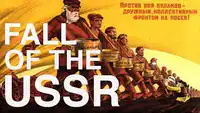
Collapse of the Soviet Union
Presentation
•
Social Studies
•
10th Grade
•
Easy
Danielle Treder
Used 31+ times
FREE Resource
11 Slides • 9 Questions
1
2
Document Analysis
Directions
Use your knowledge of the Cold War and History to complete the CRQ document analysis. Write in complete sentences using facts, details and analysis.
3
Open Ended
1. Which country, the USSR or the US, had a stronger economy in 1989 according to the chart? Explain why.
4
Open Ended
2. Infer: What is the main idea of the political cartoon?
5
Open Ended
3. Based on the information in document 1 and document 2, infer the cause and effect that led to the collapse of the Soviet Union.
6
The Soviet Union was at the height of its power by the early 1970s and its economy was its most robust. Internationally, communists were victorious in the Vietnam War and there was growing support for the ideology in South America. At the same time the economy in the United States slowed and trust in the government was at an all time low because of the Vietnam War. Up until the late 1970s, it appeared that the American policy of containment was no match for communist expansion.
1960-1970s
7
The Soviets gained nuclear capability in 1949.; setting off the Arms Race. This increased tensions b/w the two U.S. and USSR. Each country used the threat and fear associated with nukes to pressure each other and even other countries. This policy of testing one another’s willingness to go to war became known as brinkmanship.
The Arms Race
8
9
Multiple Choice
The capability to completely destroy one another through the use of nucelar weapons became known as:
M.A.D.
Mothers Against
Drugs
M.A.D.
Mosquito's ARE DANGEROUS
M.A.D.
Must Acquire Dessert
M.A.D
. Mutually Assured Destruction
10
Multiple Choice
Which was true about the military spending by the USSR during the Cold War?
They were spending a large part of their GDP on the military .
They were very cautious about spending too much money on weapons.
They could not keep up with the level of nuclear weapons of the US
They had a lot more money to spend on weapons because the USSR was wealthier than the US
11
A U.S. spy plane finds missile sites in Cuba!
1962: The Cuban Missile Crisis leads to a period of DETENTE
Cuba is only 90 miles away from the U.S.!
JFK places a naval blockade...its the closest the world every came to nuclear war
12
The close call of the Cuban Missile Crisis had the two superpowers rethinking their need for such intense nuclear arsenals.
Let's Get a Lock For This Thing
13
Partial Test Ban Treaty (1963)
Nuclear Non-Proliferation Treaty (1968)
Anti-Ballistic Missile Treaty (1972)
Helsinki Accords (1975).
Détente led to the series of summits between the leaders of two superpowers and the signing of number of international treaties:
14
At the height of the Arms Race the USSR possessed 45,000 and the U.S. had 31,255.
- This made tensions b/w the two nations very tense
WHY?
The first round of talks began in 1969 under President Nixon. After a period of negotiations, the first treaty, known as SALT I, was signed on May 26, 1972.
When?
By signing SALT I, the US and the USSR agreed to a limited number of ballistic missiles, as well as a limited number of missile deployment sites.
What?
S.A.L.T.= Strategic Arms Limitation Treaties
15
Multiple Choice
Which is NOT the purpose of Detente
To ease the tense relations between the US and USSR
To reduce the amount of nuclear warheads in the war
To build up as many nuclear warheads possible
To avoid nuclear war between the US and USSR
16
Multiple Choice
Why was the Cuban Missile Crisis a turning point in the Cold War?
It ended communism in Cuba
It allowed the United States to invade the Soviet Union
It led the two superpowers agree to reduce nuclear weapons
It led to a nuclear war
17
Multiple Choice
Which statement BEST explains the result of the Strategic Arms Limitation Talks (SALT I)?
A treaty that unified countries against the expansion of communism was established
Dictatorial leaders from countries that violated human rights were removed from power.
Economic stability in regions affected by communist rule was maintained.
The possibility of a conflict that could be escalated to a nuclear war was reduced.
18
Increased Spending leads to a slow decline for the USSR:
Soviet-Afghan War 1979-1989
By the 1980s, a large portion of the state's funds were spent on the military to support their involvement in Afghanistan and to fund the arms race with the United States. The Soviet-Afghan War resulted in heavy casualties and high costs. This led to a loss of faith in the Soviet Union.
About 15,000 Soviet soldiers were killed
35,000 were wounded
2 million Afghan civilians were killed.
19
STAGNATION
By the early 1980s, the Soviet economy began to slow down before finally reaching economic stagnation [state of not growing or progressing].
CAUSES:
"Keeping up with the U.S"- Under Pres. Reagan the US developed military technology and the Soviets didn't have the $$ to compete.
The USSR supported its satellite nations to maintain control. This was very costly.
As the Soviet Union's economy was suffering, so were theirs.
Poverty and low standards of living was on the rise.
20
Open Ended
In your own words, explain what was happening to the economy of the USSR by the mid 1980s
Show answer
Auto Play
Slide 1 / 20
SLIDE

Similar Resources on Wayground
15 questions
Lessons 7-8: Our Tradition
Lesson
•
10th Grade
16 questions
Photosynthesis and Cellular Respiration
Lesson
•
10th Grade
16 questions
Intro to Geometry - Vocab/Basics
Lesson
•
10th Grade
16 questions
Mengenal Konstitusi dan UUD NRI 1945
Lesson
•
10th Grade
14 questions
The Crusades
Lesson
•
10th Grade
15 questions
Capitalism, Socialism & Communism
Lesson
•
9th Grade
16 questions
RECONSTRUCTION LESSON
Lesson
•
11th Grade
15 questions
Parallel Construction
Lesson
•
10th Grade
Popular Resources on Wayground
10 questions
5.P.1.3 Distance/Time Graphs
Quiz
•
5th Grade
10 questions
Fire Drill
Quiz
•
2nd - 5th Grade
20 questions
Equivalent Fractions
Quiz
•
3rd Grade
15 questions
Hargrett House Quiz: Community & Service
Quiz
•
5th Grade
20 questions
Main Idea and Details
Quiz
•
5th Grade
20 questions
Context Clues
Quiz
•
6th Grade
20 questions
Inferences
Quiz
•
4th Grade
15 questions
Equivalent Fractions
Quiz
•
4th Grade
Discover more resources for Social Studies
37 questions
Review - Pretest
Quiz
•
9th - 12th Grade
20 questions
Unit 8.3 Russian Revolution Quizizz/Wayground
Quiz
•
10th Grade
11 questions
The Cold War: Crash Course US History #37
Interactive video
•
10th Grade
24 questions
SOL 12 Review
Quiz
•
10th Grade
5 questions
10.3 DOL Resource Management
Quiz
•
9th - 12th Grade
25 questions
Unit 5 Expanding World
Quiz
•
10th Grade