L16.5-DNA transcription & translation & L16.9-Univ. genetic code
Presentation
•
Science
•
9th - 12th Grade
•
Practice Problem
•
Hard
Standards-aligned

Nadia Spence
Used 2+ times
FREE Resource
12 Slides • 23 Questions
1

L16.5-DNA Transcription & Translation
L16.9-Universal Genetic Code
2
3
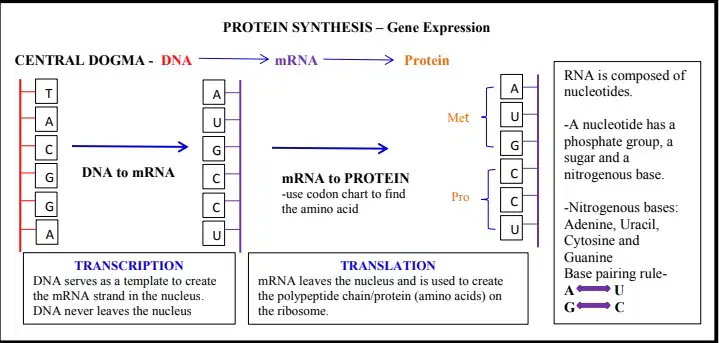
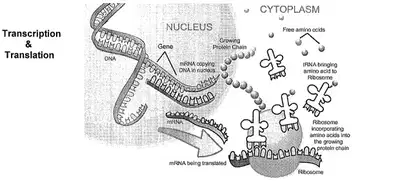
CENTRAL DOGMA - DNA is transcribed into RNA, and RNA is translated into an amino acid sequence (protein). That protein functions to cause a phenotype, or observable trait
PROTEIN SYNTHESIS
Protein synthesis = a process through which the genes in DNA are expressed into proteins.
DNA RNA PROTEIN
4
5
6
7
8
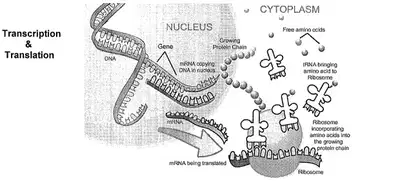
Transcription
What is transcription?
Where does it occur?
What structures/enzymes are needed?
What is the end result?
9
Translation
What is translation?
Where does it occur?
What structures/enzymes are needed?
What is the end result?
10
Let's transcribe and translate!
TRANSCRIBE THE CODE BELOW FIRST:
TAC – TTC – AAA – CCG – CGT – GGG - ATT
NOW TRANSLATE IT!
11
PRACTICE: TRANSCRIBE & TRANSLATE THE FOLLOWING DNA SEQUENCES
GTA-CGC-GTA-TAC-CGA
TTT-ACG-GCC-ATC-AGG
GAA-GTC-TGG-AAA-CCT-TAT-TAG
TAC-CGT-ATA-GGC-CGA-TGC-ATT-CAT
12
Transcription & Translation
| Transcription | Translation |
|---|---|---|
Define | | |
Location | | |
Participants | | |
Outcome | | |
13
Multiple Choice
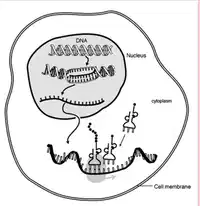
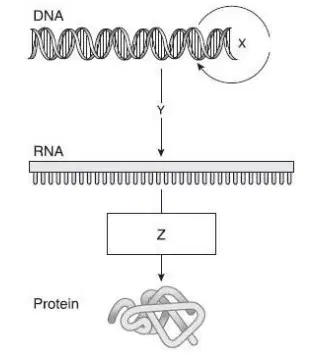
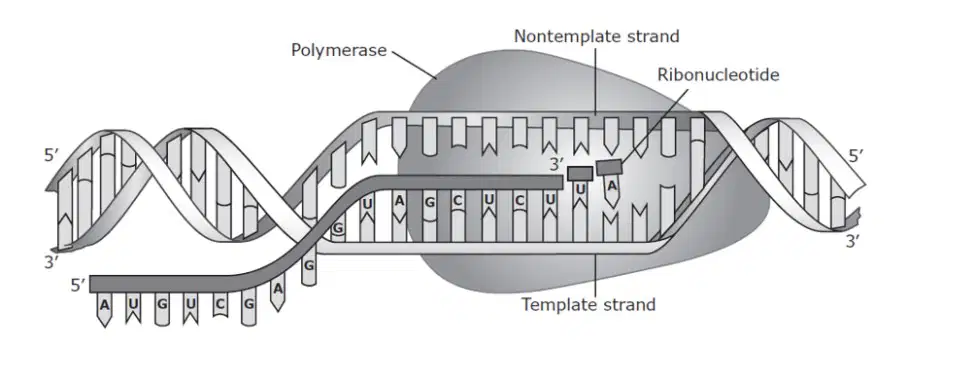
A diagram of a cellular process is shown below.
Which of the following identifies the process shown at point Z?
Translation
Translocation
Replication
Transcription
14
Multiple Choice
Which of the following carries amino acids to the site of protein synthesis?
mRNA
tRNA
rRNA
nRNA
15
Multiple Choice
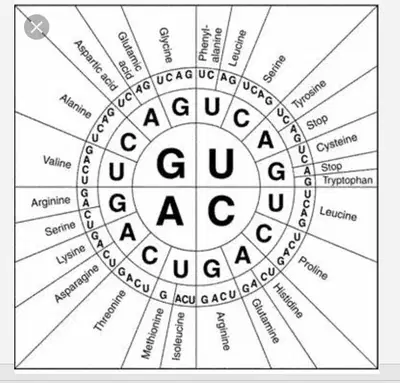
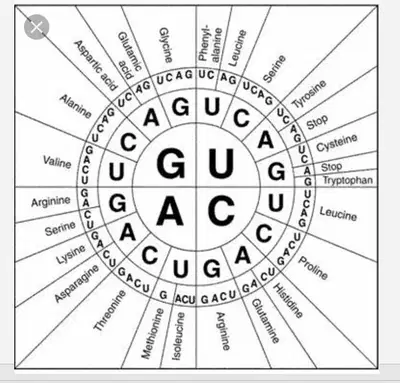
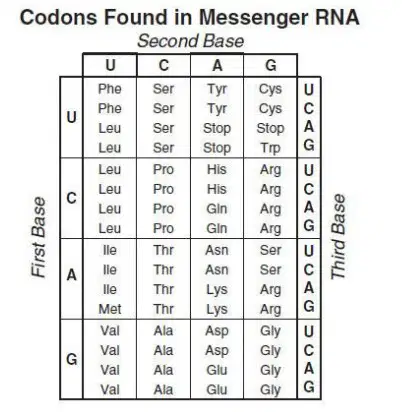
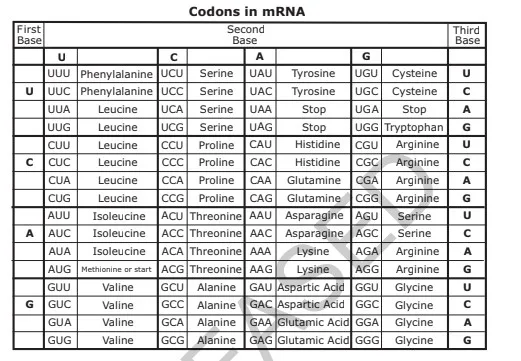
During transcription the DNA base sequence is transcribed into a complimentary mRNA sequence. A codon table like the one shown below lists the amino acids coded for by particular triads of mRNA bases. A segment of DNA has undergone a mutation in which one nucleotide has been changed. The original sequence was ACG and the new sequence is ACA. Use the codon table to determine whether or not this mutation will cause a change in the phenotype of the organism.
yes, the phenotype of the organism would change because a new amino acid will be coded
for.
yes, the phenotype of the organism would change because any change in the DNA
sequence will cause a change in phenotype.
Even though the DNA sequence changed, the sequence still codes for the
same amino acid, so no change in phenotype will occur.
It is impossible to determine if a change in phenotype will occur using only the
DNA sequence.
16
Multiple Choice
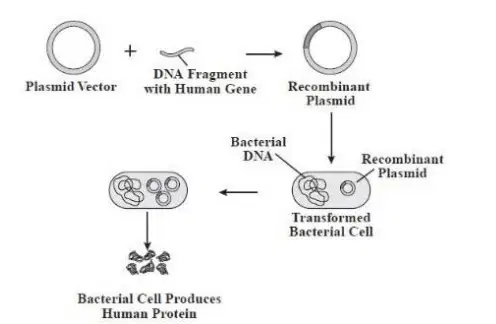
Genes for medically important proteins can be cloned and inserted into bacteria, as shown in the diagram below.
Why can bacteria recognize a human gene and then produce a human protein?
DNA replication in bacteria and humans is the same.
Bacterial cells contain the same organelles as human cells.
The basic components of DNA are the same in humans and bacteria.
Bacterial cells and human cells contain the same kind of chromosomes.
17
Multiple Choice
The sequence of DNA below is part of a gene. How many amino acids are coded for by this segment?
5' ATCAGCGCTGGC 3'
4
8
12
20
18
Multiple Choice
1.An original DNA strand with the sequence ACG – CCA – TGA – AAG is used as a template to make a new strand during DNA replication. What would be the complementary sequence of the new DNA strand?
UGC-GGU-ACU-UUC
TGC-GGU-ACT-UUC
TGC-GGT-ACT-TTC
TGG-CCT-ACT-TTG
19
Multiple Choice
1.An original DNA strand with the sequence ACG – CCA – TGA – AAG is transcribed onto mRNA. What would the sequence be like?
UGC-GGU-ACU-UUC
TGC-GGU-ACT-UUC
TGC-GGT-ACT-TTC
TGG-CCT-ACT-TTG
20
Multiple Choice
If the sequence of nucleotides, TAAGCGAAAGCA, goes through protein synthesis, assuming that there are no STOP codons, how many amino acids will be made?
4
6
3
12
21
Multiple Choice
Reference the DNA sequence within a gene reads: TCC AAT GGC CTG TTT GCA What sequence of amino acids is specified by this DNA sequence?
Arg-Leu-Pro-Asp-Lys-Arg
Thr-Phe-Iso-Arg-Stop
Trp-Phe-Leu-Gly-Asp-Ser
Ser-Leu-Pro-Asp-Lys-Arg
22
Multiple Choice
A scientist discovers a protein with the sequence Met-Cys-Val.Which mRNA sequence mightcode for this protein?
AUGUGCGUG
UACACGCAC
GUGCGUGUA
CACGCACAU
23
Multiple Choice
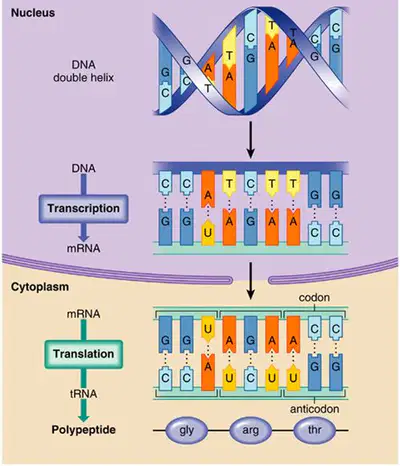
The diagram below shows an important biochemical process that occurs in cells.
Which process is represented?
Transcription
Translation
DNA replication
Protination
24
Multiple Choice
The fact that a strain of yeast with a certain defective gene can use the human version of the gene to repair itself is evidence of which of the following?
Yeast and humans share a universal genetic code.
Yeast and humans have identical DNA in their genomes.
Yeast and humans both have prokaryotic chromosomes.
Yeast and humans depend on the same food supply.
25
Multiple Choice
A scientist puts nucleotide chains of UUUUUU in a test tube under conditions allowing protein synthesis. Soon the test tube is full of polypeptide chains composed only of the amino acid phenylalanine. What does this experiment indicate?
The amino acid phenylalanine is composed of uracil.
UUU codes for the amino acid phenylalanine.
Protein synthesis malfunctions in test tubes.
Most proteins contain only one type of amino acid.
26
Multiple Choice
A segment of DNA has this sequence:
ATA GCA CAT GTA
What is the mRNA sequence transcribed from this segment?
TAT CGT GTA CAT
TAT GCT CTA GAT
UAU CGU GUA CAU
UAU GCU CUA CAU
27
Multiple Choice
What are the subunits of DNA and their function?
nucleotides that store information
monosaccharides that provide quick energy for the cell
lipids that store energy and provide insulation
proteins that provide the building blocks for the structural components of
organisms
28
Multiple Choice
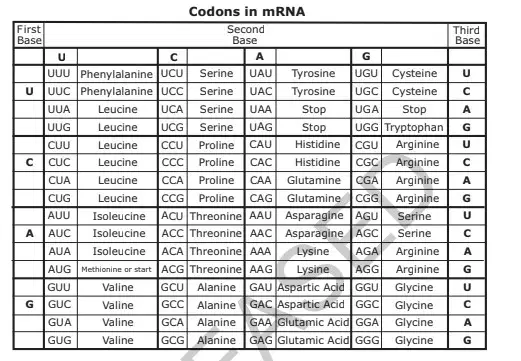
This chart shows which amino acids are coded for by different combinations of mRNA nucleotides.
Which amino acids are coded for by an mRNA segment that reads CAG GUG?
arginine and valine
isoleucine and arginine
glutamine and valine
valine and isoleucine
29
Multiple Choice
How does DNA code for proteins in a cell?
by creating a new double helix structure
by using its phosphate and sugar molecules
by adding more hydrogen bonds to its structure
by arranging certain nitrogen bases of the cell in a particular order
30
Multiple Choice
The genetic code is nearly universal, meaning that almost all organisms use the
same genetic code. Which statement does NOT explain why the genetic code is
nearly universal?
All organisms can grow, respond to stimuli, and reproduce.
All organisms are genetically related to all other organisms.
All organisms use each codon for the same amino acid.
All organisms encode their genes using DNA or RNA.
31
Multiple Choice
According to the genetic code, the mRNA codon UCG codes for the amino acid
serine in frogs, humans, and horses. What does this fact tell you?
A mutation in one base will always have a physical effect on the
resulting protein.
The genetic code does not dictate the amino acid sequence of proteins.
The genetic code is the same for nearly all organisms.
A mutation in one base could have absolutely no physical effect on the
resulting protein.
32
Multiple Choice
The genetic code is nearly universal. That means, with few exceptions, the same
codons code for the same amino acids in all organisms. What does the near
universality of the genetic code suggest?
All life-forms arose about the same time in Earth’s history.
All life-forms have a common evolutionary ancestor.
All life-forms can reproduce with one another.
All life-forms have the same number of genes.
33
Multiple Choice
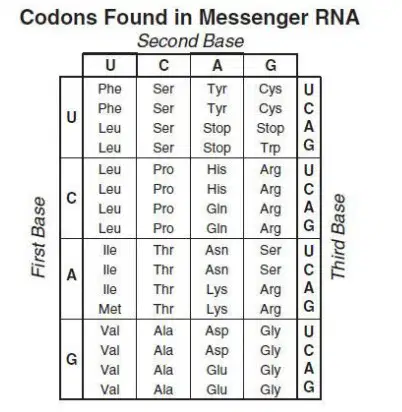
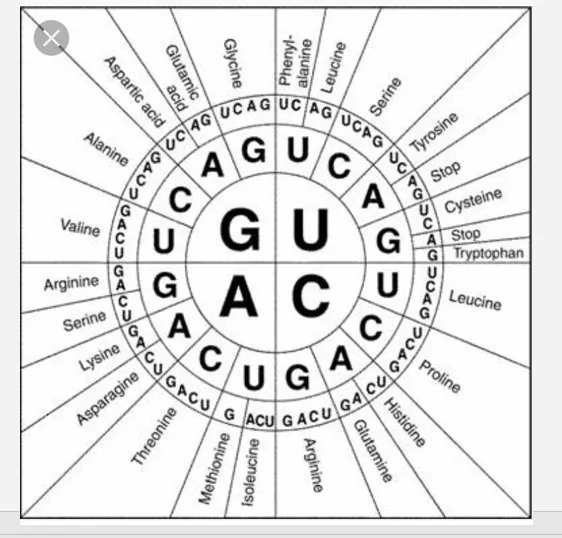
Look at the image above. Translate the following codons from a pig's mRNA
strand: UCC AGG UUA. What amino acids does this code for and would the
same codons from a bacteria code for the same amino acids?
It codes for serine, arginine, and leucine. The same codons in a pig
would code for the same amino acids in a bacterium because the
genetic code is universal.
It codes for arginine, serine, and asparagine. The codons from a pig
would be different from a bacterium because they look different and so
they will be made from different amino acids.
It codes for arginine, serine, and asparagine. The same codons in a pig
would code for the same amino acids in a bacterium because the
genetic code is universal.
It codes for serine, arginine, and leucine. The codons from a pig would
be different from a bacterium because they look different and so they
will be made from different amino acids.
34
Multiple Choice
Which factor most affects the order of amino acids in a protein?
the DNA located in the nucleus of the cell
the cell in which the protein is located
the amount of ATP available for the cell’s use
the area in a cell where proteins are produced
35
Multiple Choice
Which statement best describes the relationship that exists among proteins, DNA,
and cells?
Proteins combine to produce cells, which produce DNA.
Proteins are made up of DNA, which determines the cells that are produced.
DNA is made up of proteins, which tell a cell how to function.
Cells contain DNA, which controls the production of proteins.
L16.5-DNA Transcription & Translation
L16.9-Universal Genetic Code
Show answer
Auto Play
Slide 1 / 35
SLIDE

Similar Resources on Wayground
31 questions
Doppler Effect
Presentation
•
9th - 12th Grade
32 questions
Types of Chemical Reactions
Presentation
•
9th - 12th Grade
25 questions
Solar and Wind Energy
Presentation
•
9th - 12th Grade
26 questions
Properties of Life LESSON
Presentation
•
10th - 12th Grade
27 questions
Ecology
Presentation
•
9th - 12th Grade
29 questions
Parts of the Ear
Presentation
•
10th - 12th Grade
27 questions
PS03-3 Classifying Matter
Presentation
•
9th - 11th Grade
28 questions
Reading a Triple Beam Balance
Presentation
•
9th - 12th Grade
Popular Resources on Wayground
15 questions
Grade 3 Simulation Assessment 1
Quiz
•
3rd Grade
22 questions
HCS Grade 4 Simulation Assessment_1 2526sy
Quiz
•
4th Grade
16 questions
Grade 3 Simulation Assessment 2
Quiz
•
3rd Grade
19 questions
HCS Grade 5 Simulation Assessment_1 2526sy
Quiz
•
5th Grade
17 questions
HCS Grade 4 Simulation Assessment_2 2526sy
Quiz
•
4th Grade
20 questions
Equivalent Fractions
Quiz
•
3rd Grade
24 questions
HCS Grade 5 Simulation Assessment_2 2526sy
Quiz
•
5th Grade
20 questions
Math Review
Quiz
•
3rd Grade
Discover more resources for Science
20 questions
Earth Day Trivia
Quiz
•
9th - 12th Grade
100 questions
Biology EOC Review
Quiz
•
9th - 12th Grade
20 questions
Earth Day
Quiz
•
3rd - 12th Grade
38 questions
Biology EOC Review Game
Quiz
•
10th Grade
20 questions
Human Impact on the Environment Review #2
Quiz
•
9th Grade
10 questions
Exploring Natural Selection Concepts
Interactive video
•
6th - 10th Grade
20 questions
Balancing Chemical Equations
Quiz
•
9th Grade
10 questions
Exploring Air Masses and Weather Fronts
Interactive video
•
6th - 10th Grade