

Ancient Rome_ Plebeians and Patricians

Presentation
•
Social Studies
•
6th - 8th Grade
•
Practice Problem
•
Medium

Rebecca Parker
Used 51+ times
FREE Resource
10 Slides • 8 Questions
1
Ancient Rome
Plebeians and Patricians
2
Roman citizens were divided up into two distinct classes: the plebeians and the patricians. The patricians were the wealthy upper class people. Everyone else was considered a plebeian.

3
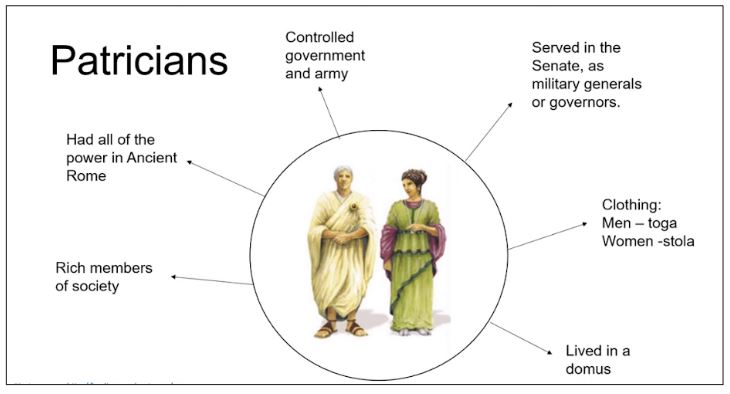
The patricians were the ruling class of the early Roman Empire. Only certain families were part of the patrician class and you had to be born a patrician. The patricians were only a small percentage of the Roman population, but they held all the power.
4
Multiple Choice
1) To what group did the wealthy upper class of Ancient Rome belong to?
Plebeians
Patricians
5
Multiple Choice
How did you become a patrician in Ancient Rome?
By making a lot of money
By being born into a patrician family
By doing good in the community
By getting elected to public office
By paying dues and joining the patrician club
6
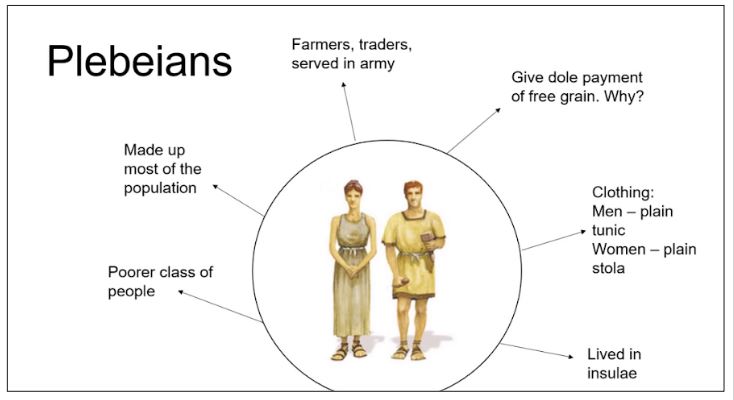
All the other citizens of Rome were Plebeians. Plebeians were the farmers, craftsmen, laborers, and soldiers of Rome.
7
Multiple Choice
Who were included in the plebeians?
The common people of Rome
Farmers
Craftsmen, laborers, and soldiers
All of the above
8
In Early Rome
In the early stages of Rome, the plebeians had few rights. All of the government and religious positions were held by patricians.
The patricians made the laws, owned the lands, and were the generals over the army. Plebeians couldn't hold public office and were not even allowed to marry patricians.
9
Multiple Choice
Which of the following is true about the rights of plebeians in early Rome?
They could hold public office
They could not marry a patrician
They could own land
They could become generals in the army
10
The Plebeians Revolt
Starting around 494 BC, the plebeians began to fight against the rule of the patricians. This struggle is called the "Conflict of the Orders." Over the course of around 200 years the plebeians gained more rights. They protested by going on strike. They would leave the city for a while, refuse to work, or even refuse to fight in the army. Eventually, the plebeians gained a number of rights including the right to run for office and marry patricians.
11
Multiple Choice
How did the plebeians revolt against the patricians in early Rome?
They left the city
They refused to work
They refused to fight in battle
All of the above
12
The Law of the Twelve Tables
One of the first concessions that the plebeians got from the patricians was the Law of the Twelve Tables.
The Twelve Tables were laws that were posted in the public for all to see.
They protected some basic rights of all Roman citizens regardless of their social class.

13
Multiple Choice
What early laws protected the basic rights of all Roman citizens regardless of class?
Bill of Rights
Magna Carta
Roman Constitution
Law of the Twelve Tables
14

15
Plebeian Officers
Eventually the plebeians were allowed to elect their own government officials. They elected "tribunes" who represented the plebeians and fought for their rights. They had the power to veto new laws from the Roman senate.
Plebeian Nobles
As time went on, there became few legal differences between the plebeians and the patricians. The plebeians could be elected to the senate and even be consuls. Plebeians and patricians could also get married. Wealthy plebeians became part of the Roman nobility. However, despite changes in the laws, the patricians always held a majority of the wealth and power in Ancient Rome.
16
Multiple Choice
True or False: In the latter stages of the Roman Empire there were few legal differences between the plebeians and the patricians.
TRUE
FALSE
17
Interesting Facts About Plebeians and Patricians
A third social class in Roman society was the slaves. Around one third of the people living in Rome were slaves.
One of Rome's most famous senators, Cicero, was a plebeian. Because he was the first of his family to be elected to the senate, he was called a "New Man."
In general, plebeians and patricians did not mix socially.
Julius Caesar was a patrician, but he was sometimes considered a champion of the common people.
The Plebeian Council was led by the elected tribunes. Many new laws were passed by the Plebeian Council because the procedures were simpler than in the senate. The Plebeian Council lost its power with the fall of the Roman Republic.
Freshmen students in the United States military academies are nicknamed "plebs."
Some of the most famous patrician families include Julia (Julius Caesar), Cornelia, Claudia, Fabia, and Valeria.
18
Multiple Choice
What was the lowest social class in Ancient Rome?
Slaves
Patricians
Plebeians
Ancient Rome
Plebeians and Patricians
Show answer
Auto Play
Slide 1 / 18
SLIDE
Similar Resources on Wayground

14 questions
Conflict and Cooperation in Southwest Asia and North Africa
Presentation
•
5th - 7th Grade
12 questions
Food Print -Waste
Presentation
•
6th - 8th Grade
14 questions
5 Themes of Geography Notes
Presentation
•
6th - 8th Grade
15 questions
Women During WW1
Presentation
•
6th - 8th Grade
16 questions
Articles of Confederation
Presentation
•
6th - 8th Grade
14 questions
Economics Terms Preview
Presentation
•
6th - 7th Grade
15 questions
Notes: Argumentative Writing
Presentation
•
7th - 8th Grade
14 questions
Executive Branch
Presentation
•
7th Grade
Popular Resources on Wayground
19 questions
Naming Polygons

Quiz
•
3rd Grade
10 questions
Prime Factorization
Quiz
•
6th Grade
20 questions
Math Review
Quiz
•
3rd Grade
15 questions
Fast food
Quiz
•
7th Grade
20 questions
Main Idea and Details
Quiz
•
5th Grade
20 questions
Context Clues
Quiz
•
6th Grade
20 questions
Inferences
Quiz
•
4th Grade
19 questions
Classifying Quadrilaterals
Quiz
•
3rd Grade
Discover more resources for Social Studies
22 questions
Bill of Rights Scenarios
Quiz
•
7th Grade
154 questions
Civics & Economics SOL Review
Quiz
•
8th Grade
50 questions
The 50 states of the U.S.A.
Quiz
•
6th Grade
40 questions
SS Final Study Guide
Quiz
•
6th Grade
35 questions
Civics EOC Review: Category 1
Quiz
•
7th Grade
48 questions
Ultimate Civics EOC Review
Quiz
•
7th Grade
20 questions
The United States 1800s-1900s
Quiz
•
6th - 8th Grade
40 questions
Civics and Economics SOL Review
Quiz
•
8th Grade