Search Header Logo
Organic Chemistry

Organic Chemistry

Assessment

Presentation

Biology, Science

9th - 12th Grade

Medium

NGSS
HS-LS1-6, HS-PS1-1, HS-LS3-1

+1

Standards-aligned

Created by

Teresa Schlueter

Used 28+ times

FREE Resource

39 Slides • 26 Questions

1

Organic Chemistry

by Teresa Schlueter

2

​What is organic chemistry?

The study of carbon compounds.

Carbon

  • ​the backbone of biological molecules

media

3

Carbon and Covalent bonds

media
  • ​Carbon has 4 valence electrons (outer shell electrons)

  • ​Allows for several types of covalent bonds.

4

Carbon and Covalent bonds

media
  • ​able to form chains

  • ​able to form rings

media

5

media

6

Multiple Choice

Question image
Which of the following elements is required in an organic compound?
1
nitrogen
2
oxygen
3
carbon
4
sodium

7

Fill in the Blank

How many valency does carbon have

8

Multiple Choice

C stands for?
1
cat
2
calcium
3
carbon
4
crypton

9

Multiple Choice

Question image

How many chemical bonds can each carbon atom form?

1

one

2

two

3

three

4

four

10

Macromolecule Formation

  • Monomers

    • ​small units that can join together to form polymers

  • ​Polymers

    • ​large compounds formed from combinations of many monomers

media

11

Macromolecule Formation

  • Monomers to polymers

    • ​monomers join together by dehydration sysnthesis

media

12

13

Multiple Choice

A single unit that can bond to other single units to form a polymer is a:

1

Lego

2

Monounits

3

Monopoly

4

Monomer

14

Multiple Choice

Monomers bond to other monomers through this process:

1

Hydrolysis

2

Dehydration synthesis

3

Gluation

4

Freezing

15

Multiple Choice

A very large organic molecule made up of chains of smaller molecules is called a

1

monomer

2

polymer

3

saturated hydrocarbon

4

substituted hydrocarbon

16

Multiple Choice

Monomers combine to form ________ through the process of ________.
1
polymers; hydrolysis
2
polymers; dehydration synthesis
3
monomers; hydrolysis
4
monomers; dehydration synthesis

17

Multiple Choice

Polymer's split apart to form ________, by __________.

1

monomers, hydrolysis

2

monomers, dehydration synthesis

3

amino acids, hydrolysis

4

amino acids, dehydration synthesis

18

4 types of polymers

  • ​Carbohydrates

  • ​Lipids

  • ​Proteins

  • ​Nucleic acids

media

19

Multiple Choice

The four organic compounds found in living things are?
1
Carbohydrates, Lipids, Nucleic Acids, and Oxygen
2
Carbohydrates, Lipids, Proteins, and Carbon
3
Carbohydrates, Lipids, Proteins, Nucleic Acids
4
Carbon, Lipids, Proteins, Nucleic Acids

20

media

21

Macromolecule Chart Carbohydrates

  • Elements

    • ​C

    • ​H

    • ​O

  • Monomer

    • ​C, H, O in a 1-2-1 ratio

media

22

Macromolecule Chart​

​Carbohydrates

  • Function(s)

    • ​energy

    • storage

    • structure

  • Examples

    • glucose

    • ​starch

    • ​glycogen

media

23

Macromolecule Chart​ Carbohydrates

  • Function(s)

    • ​energy

    • ​storage

    • ​structure

media

24

Macromolecule Chart​ Carbohydrates

  • Examples

    • ​glucose

    • ​starch

    • ​glycogen

    • sucrose

media

25

Macromolecule Chart​: Carbohydrates

  • Unusual Information

  • Monosaccharide

    • simple sugar

      glucose

media

26

Macromolecule Chart​: Carbohydrates

  • Unusual Information

  • Disaccharide

    • 2 simple sugars

    • sucrose

media

27

Macromolecule Chart​: Carbohydrates

  • Unusual Information

  • Polysaccharide

    • many simple sugars

    • starch/glycoge

media

28

Multiple Choice

The monomer Glucose/Monosaccharides make up the polymer....

1

Proteins

2

Lipids

3

Nucleic Acids

4

Carbohydrates

29

Multiple Choice

What is the ratio carbon:hydrogen:oxygen in carbohydrates?
1
1:1:1
2
1:2:1
3
2:1:1
4
2:1:2

30

Multiple Choice

Question image

This molecule could be the building block of...

1

nucleic acids

2

proteins

3

lipids

4

polysaccharides

5

waxes

31

media

32

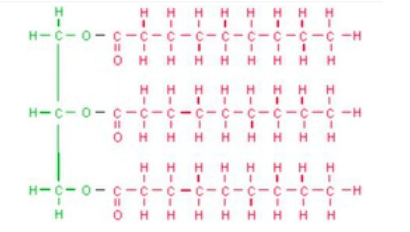
Macromolecule Chart​ Lipids

  • Elements

    • ​C

    • ​H

  • Monomer

    • ​Glycerol

      • ​3 Carbons

      • ​1 alcohol

      • ​3 fatty acid chain

media

33

Macromolecule Chart​ Lipids

  • Function(s)

    • ​store energy

    • ​biological membranes

    • waterproof covering

    • ​hormones

    • ​structural support

media

34

Macromolecule Chart​ Lipids

  • Examples

    • ​fats

    • ​oils

    • ​waxes

    • steroids

    • ​corn oil

    • ​hormones

media

35

Macromolecule Chart​ Lipids

  • Unusual Information

  • Saturated

    • Each C in fatty acid chain has single bond with another C

media

36

Macromolecule Chart​ Lipids

  • Unusual Information

  • Monounsaturated

    • Have 1 C in fatty acid chain with a double bond to another C

media

37

Macromolecule Chart​ Lipids

  • Unusual Information

  • Polyunsaturated

    • 2 or more C in fatty acid chain have double bond with another C

media

38

Multiple Choice

Question image
Is this hydrocarbon saturated or unsaturated? 
1
saturated
2
unsaturated

39

Multiple Choice

The monomer Fatty acids make up the polymer....

1

Proteins

2

Lipids

3

Nucleic Acids

4

Carbohydrates

40

Multiple Choice

Question image
Which biomolecule is this a picture of?
1
Protein
2
Nucleic Acid
3
Lipid
4
Carbohydrate

41

media

42

Macromolecule Chart​: Nucleic Acids

  • Elements

    • ​C

    • ​H

    • ​N

    • ​O

    • ​Phosphate (PO4)

media

43

Macromolecule Chart​: Nucleic Acids

  • Monomer

    • ​Nucleotides

      • ​5 carbon sugar

      • ​phosphate group

      • ​nitrogenous base

media

44

Macromolecule Chart​: Nucleic Acids

  • Function(s)

    • ​store and transmit genetic information

    • ​biological membranes

    • blueprint for making proteins

media

45

Macromolecule Chart​: Nucleic Acids

  • Examples

    • ​Deoxyribonucleic acid

      • DNA

    • RIbonucleic Acid

      • RNA

media
media

46

Macromolecule Chart​: Nucleic Acids

  • Unusual Information

  • in charge of characteristics of life

  • ​at least 2 nucleotides combined by a covalent bonds

media

47

Multiple Choice

What are the monomers of DNA?
1
glycerols
2
amino acids
3
fatty acids
4
nucleotides

48

Multiple Choice

Question image
Building block of ...
1
carbohydrates
2
proteins
3
lipids
4
nucleic acids

49

Multiple Choice

The monomer Nucleotides make up the polymer....

1

Proteins

2

Lipids

3

Nucleic Acids

4

Carbohydrates

50

media

51

Macromolecule Chart​: Proteins

  • Elements

    • ​C

    • ​H

    • ​N

    • ​O

media

52

Macromolecule Chart​: Proteins

  • Monomer

    • ​Amino Acids

      • ​Amino group (NH)

      • ​Carboxyl group (COOH)

      • ​H off central C

      • ​R-group

media

53

Macromolecule Chart​: Proteins

  • Function(s)

    • ​controls rate of reactions for life processes

    • ​forms bones and muscles

media

54

Macromolecule Chart​: Proteins

  • Function(s)

    • ​transports substances in / out of cells

    • helps fight diseases

media

55

Macromolecule Chart​: Proteins

  • Examples

    • ​Collagen

    • Carotene

    • ​Enzymes

    • ​Hemoglobin

media

56

Macromolecule Chart​: Proteins

  • Unusual Information

  • more than 20 amino acids (aa) formed in nature

  • ​bind to other aa by binding amino group to carboxyl group

media

57

Macromolecule Chart​: Proteins

  • Unusual Information

  • ​form poly peptide chains

  • ​Fold into complex shapes

media

58

Multiple Choice

Proteins are composed of what smaller subunits?
1
amino acids
2
nucleic acids
3
fatty acids
4
nucleotides

59

Multiple Choice

Question image
Which biomolecule is this a picture of? (Hint: it is made of amino acids)
1
Proteins
2
Nucleic Acids
3
Lipids
4
Carbohydrates

60

Multiple Choice

Question image
Which macromolecule is this?
1
carbohydrate
2
lipid
3
protein
4
nucleic acid

61

media

62

Multiple Choice

Which group of biomolecules provides quick energy to organisms?
1
proteins
2
carbohydrates
3
lipids
4
nucleic acids

63

Multiple Choice

Which group of organic molecules serve as long-term energy storage and waterproof coverings?
1
proteins
2
carbohydrates
3
lipids
4
nucleic acids

64

Multiple Choice

Which group of organic molecules speed up chemical reactions and serve as immune defense mechanisms?
1
proteins
2
carbohydrates
3
nucleic acids
4
lipids

65

Multiple Choice

Genetic information is stored in which class of organic compounds?
1
proteins
2
lipids
3
nucleic acids
4
carbohydrates

Organic Chemistry

by Teresa Schlueter

Show answer

Auto Play

Slide 1 / 65

SLIDE