Search Header Logo
Accuracy, Precision and Measurement

Accuracy, Precision and Measurement

Assessment

Presentation

Mathematics

9th - 10th Grade

Hard

Created by

Judy Hutton

Used 2+ times

FREE Resource

20 Slides • 42 Questions

1

Accuracy, Precision and Measurement

Precision and accuracy are ways that scientists think about error.

Error, every measurement carries a level of uncertainty which is known as an error.

Accuracy refers to how close a measurement is to the true or accepted value.

Precision refers to how close measurements of the same item are to each other. Precision is independent of accuracy. That means it is possible to be very precise but not very accurate, and it is also possible to be accurate without being precise. The best quality scientific observations are both accurate and precise.

media

2

Lesson objectives:

  • To be able to convert between measurements

  • To be able to calculate compound measurements to a required accuracy

  • To be able to calculate upper and lower bounds of error

  • ​Calculate significant digits

  • ​understand the difference between accuracy and Precision

3

Accuracy and Precision

by Cesar Pereyra

media

4

5

Multiple Choice

Question image

You are measuring length with a meter stick. However, you do not realize that the first 4.0 centimeters of the meter stick are missing because a hungry beaver made a snack of it earlier that day. The measurements you take with the meter stick will be

1

Accurate, but imprecise

2

Precise, but inaccurate

3

Imprecise and inaccurate

4

Accurate and precise

6

Multiple Choice

Question image

Which method would most likely increase the precision of the measurements you can take?

1

Have two different people measure with the same tool

2

Hold your breath when you measure

3

Switch to a tool that is more finely incremented

4

Accurate and precise

7

Multiple Choice

Question image

You are setting up a drill to make a hole in a circuit board. Which of the following is NOT a potential advantage of your efforts?

1

The more precise you are, the less difficult and/or more expensive it is to set up the process

2

You will tend to drill the hole in the right place each time

3

You will end up with less wasted product

4

You will have more options as to where exactly you want the hole placed

8

Open Ended

Question image

Agree or disagree with the following statement: “We can never be 100% certain of any measurement because at some point we’ll reach the limit of precision. After that, it is all just a guess.” Enter response below!

9

media

10

Significant Digits

1. All non-zero numbers ARE significant. The number 33.2 has THREE significant figures because all of the digits present are non-zero.

2. Zeros between two non-zero digits ARE significant. 2051 has FOUR significant figures. The zero is between a 2 and a 5.

3. Leading zeros are NOT significant. They're nothing more than "place holders." The number 0.54 has only TWO significant figures. 0.0032 also has TWO significant figures. All of the zeros are leading.

4. Trailing zeros to the right of the decimal ARE significant. There are FOUR significant figures in 92.00.

92.00 is different from 92: a scientist who measures 92.00 milliliters knows his value to the nearest 1/100th milliliter; meanwhile his colleague who measured 92 milliliters only knows his value to the nearest 1 milliliter. It's important to understand that "zero" does not mean "nothing." Zero denotes actual information, just like any other number. You cannot tag on zeros that aren't certain to belong there.

11

5. Trailing zeros in a whole number with the decimal shown ARE significant. Placing a decimal at the end of a number is usually not done. By convention, however, this decimal indicates a significant zero. For example, "540." indicates that the trailing zero IS significant; there are THREE significant figures in this value.

6. Trailing zeros in a whole number with no decimal shown are NOT significant. Writing just "540" indicates that the zero is NOT significant, and there are only TWO significant figures in this value.

7. Exact numbers have an INFINITE number of significant figures. This rule applies to numbers that are definitions. For example, 1 meter = 1.00 meters = 1.0000 meters = 1.0000000000000000000 meters, etc.

So now back to the example posed in the Rounding Tutorial: Round 1000.3 to four significant figures. 1000.3 has five significant figures (the zeros are between non-zero digits 1 and 3, so by rule 2 above, they are significant.) We need to drop the final 3, and since 3 < 5, we leave the last zero alone. so 1000. is our four-significant-figure answer. (from rules 5 and 6, we see that in order for the trailing zeros to "count" as significant, they must be followed by a decimal. Writing just "1000" would give us only one significant figure.)

12

8. For a number in scientific notation: N x 10x, all digits comprising N ARE significant by the first 6 rules; "10" and "x" are NOT significant. 5.02 x 10⁴ has THREE significant figures: "5.02." "10 and "4" are not significant.

Rule 8 provides the opportunity to change the number of significant figures in a value by manipulating its form. For example, let's try writing 1100 with THREE significant figures. By rule 6, 1100 has TWO significant figures; its two trailing zeros are not significant. If we add a decimal to the end, we have 1100., with FOUR significant figures (by rule 5.) But by writing it in scientific notation: 1.10 x 10³, we create a THREE-significant-figure value

13

media

14

media

15

Fill in the Blank

How many significant digits are in 101,407,063

16

Fill in the Blank

Identify the number of significant digits in 0.0076

17

media

18

media

19

media

20

media

21

Fill in the Blank

Starter:

Round 1403.06 to two significant figures

22

Fill in the Blank

Round 0.002002 to 3 significant figures

23

Multiple Choice

It is a measure of how close measurements come to each other when they are made in the same way

1

Accuracy

2

Precision

3

Error

4

Extrapolation

24

Fill in the Blank

Estimate The answer to:

2.497 × 1.992.497\ \times\ 1.99  

25

Multiple Choice

Question image
1

Student A

2

Student B

3

Student C

4

Cannot be determined

26

Fill in the Blank

Estimate the answer to:

3.27 × 4.491.782\frac{3.27\ \times\ 4.49}{1.78^2}  

27

Multiple Choice

How close a measurement is to the accepted value is called..

1

Accuracy

2

Precision

3

Significant

4

Estimate

28

Converting Measures

Make sure to convert all measurements to the same unit!!!

media

29

Multiple Choice

Question image
This bullseye demonstrates...
1

High Accuracy & High Precision

2

High Accuracy & Low Precision

3

Low Accuracy & High Precision

4

Low Accuracy & Low Precision

30

Fill in the Blank

Convert 2340 m into km

.

31

Multiple Choice

Question image
?
1
High Accuracy & High Precision
2
High Accuracy & Low Precision
3
Low Accuracy & High Precision
4
Low Accuracy & Low Precision

32

Multiple Choice

Convert 20cm into mm

1

2 mm

2

40 mm

3

200 mm

4

20 mm

33

Multiple Choice

The students measured length during a science experiement, they got 12 cm. But the actual measurement was 14.25 cm. What was the percent error?
1
15.79%
2
18.75%
3
2.25%
4
18%

34

Multiple Choice

The weight capacity of a bridge is 3000kg. A truck weighing 2.7 tonne is trying to cross. Will the bridge be able to hold the weight?

1

Yes

2

No

35

Multiple Choice

Jessie estimates the weight of her cat to be 8 pounds.  The actual weight of the cat was 10 pounds.  Find the percent error.  
1
15%
2
20%
3
25%
4
30%

36

Fill in the Blank

Convert 1m2 to cm

37

Multiple Choice

Which is the more precise measurement?

1

4 mL

2

4.3 mL

3

4.30 mL

4

4.300 mL

38

Compound measures describe how one quantity changes in proportion to another

  • the units for a compound measure are of the form x / b (e.g speed is measured in m/s)

  • be careful of what units the question wants the final answer in (you may have to convert measurements!)

media

39

Multiple Choice

Question image
Describe the accuracy and precision of the image
1
Accurate and Precise
2
Accurate and not precise
3
Not Accurate and Precise
4
not accurate and not precise

40

Fill in the Blank

A car is travels 10 miles in 4 hours. Calculate the average speed (mph)

41

Multiple Choice

How close a measurement is to the true value is called..

1

Accuracy

2

Precision

3

Significant

4

Estimate

42

Fill in the Blank

Calculate the density of a material with a mass of 480 kg and volume of 

1m31m^3  

43

Multiple Choice

Question image
volume?
1
48 mL
2
48.2 mL
3
48.25 mL
4
4 mL

44

Fill in the Blank

A cyclist takes 1 hour to travel 80 km. Calculate the average speed ( in Km per minute)

45

Multiple Choice

Question image
Volume?
1
63.5 mL
2
63 mL
3
63.55 mL
4
6 mL

46

Fill in the Blank

The mass of a meteorite is given as 235.6 g. Find the lower bound of the mass

47

Multiple Choice

Question image
This image is an example of...
1
precision ONLY
2
accuracy ONLY
3
BOTH precision and accuracy
4
NEITHER precision and accuracy 

48

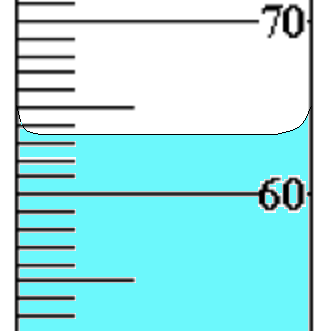
Measurements are not exact. Their accuracy depends on the precision of various factors (equipment, human error ... e.t.c)

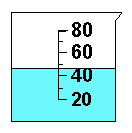
  • Look at the smallest place value in the measurement (e.g 0.1)

  • Half that value to get the error (e.g 0.05)

  • Add and take away the error to find the upper and lower bound (127.3 + 0.05 127.3 - 0.05)

media

49

Multiple Choice

Question image

Which Student is the most Precise?

1

Alex

2

Shandra

3

Luis

50

​Accuracy vs Precision

What is Accuracy?

Accuracy is defined as ‘the degree to which the result of a measurement conforms to the correct value or a standard’ and essentially refers to how close a measurement is to its agreed value.

What is Precision?

Precision is defined as ‘the quality of being exact’ and refers to how close two or more measurements are to each other, regardless of whether those measurements are accurate or not. It is possible for precision measurements to not be accurate.

What is the difference between Accuracy and Precision?

Both accuracy and precision reflect how close a measurement is to an actual value, but they are not the same. Accuracy reflects how close a measurement is to a known or accepted value, while precision reflects how reproducible measurements are, even if they are far from the accepted value. Measurements that are both precise and accurate are repeatable and very close to true values.

51

Accuracy vs Precision

Example of the difference between Accuracy and Precision…

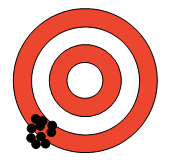
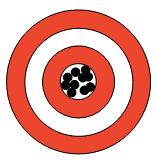
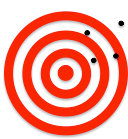
The example of a darts board is often used when talking about the difference between accuracy and precision.

Accurately hitting the target means you are close to the center of the target, even if all the marks are on different sides of the center. Precisely hitting a target means all the hits are closely spaced, even if they are very far from the center of the target.

52

Multiple Choice

A set of data are all close to each other, but they are not close to the actual value.  This set of data can be described as...

1

accurate

2

precise

3

both precise and accurate

53

Multiple Choice

A set of data are all close to each other, and they are close to the actual value.  This set of data can be described as...

1

accurate

2

precise

3

both precise and accurate

54

Multiple Choice

It is a measure of how close measurements come to each other when they are made in the same way

1

Accuracy

2

Precision

3

Error

4

Extrapolation

55

Multiple Choice

Question image
1
Student A
2
Student B
3
Student C
4
Cannot be determined

56

Multiple Choice

How close a measurement is to the accepted value is called..

1

Accuracy

2

Precision

3

Significant

4

Estimate

57

Multiple Choice

Question image
This bullseye demonstrates...
1
High Accuracy & High Precision
2
High Accuracy & Low Precision
3
Low Accuracy & High Precision
4
Low Accuracy & Low Precision

58

Multiple Choice

Question image
?
1
High Accuracy & High Precision
2
High Accuracy & Low Precision
3
Low Accuracy & High Precision
4
Low Accuracy & Low Precision

59

Multiple Choice

Question image
Describe the accuracy and precision of the image
1
Accurate and Precise
2
Accurate and not precise
3
Not Accurate and Precise
4
not accurate and not precise

60

Multiple Choice

A set of data are all close to each other, and they are close to the actual value.  This set of data can be described as...
1
accurate
2
precise
3
both precise and accurate

61

Multiple Choice

Question image

Which Student is the most Precise?

1

Alex

2

Shandra

3

Luis

62

Accuracy, Precision and Measurement

Precision and accuracy are ways that scientists think about error.

Error, every measurement carries a level of uncertainty which is known as an error.

Accuracy refers to how close a measurement is to the true or accepted value.

Precision refers to how close measurements of the same item are to each other. Precision is independent of accuracy. That means it is possible to be very precise but not very accurate, and it is also possible to be accurate without being precise. The best quality scientific observations are both accurate and precise.

media

Show answer

Auto Play

Slide 1 / 62

SLIDE