

Unit 3: Plants and Animals

Presentation
•
Science
•
3rd Grade
•
Medium
+2
Standards-aligned

Shevonne Flores
Used 24+ times
FREE Resource
18 Slides • 16 Questions
1
Unit 3: Plants and Animals

2
Plant Life Cycle

3
Stages of a Plants Life Cycle
Most plants come from seeds. A seed germinates when it breaks open and a seedling grows out of it.
The seedling grows into an adult plant. The adult plant makes flowers.
The flowers fall off the plant, and the plant makes fruit. The fruit holds the seeds.

4
Pollination
Plants that make seeds also make pollen.
Pollination happens when pollen is moved from the male plant part to the female plant part.
Wind, water, and animals help move pollen from plant to plant.

5
Mosses and Ferns
Mosses and ferns make spores instead of seeds.
These spores are part of the process for growing new mosses and ferns.

6
Multiple Choice
7
Multiple Select
8
Multiple Choice
9
Multiple Choice
10
Multiple Choice
11
Animal Life Cycle

12
Life Cycles
An animal's life cycle begins at birth.
A life cycle is all of the changes that happen to an animal or plant until it reproduces.
Many very different animals go through similar changes.

13
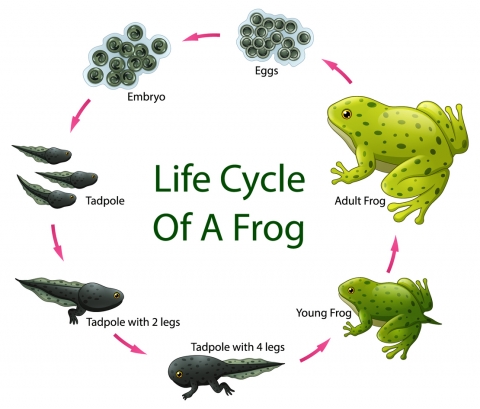
Frog Life Cycle
Different animals have different life cycles.
Some young animals do not look like small versions of their parents.
Their bodies change even more during their life cycles.
They go through metamorphosis or a major change in the body form of an animal during its life cycle.
14
Insect Life Cycle
Most insects undergo metamorphosis. as they develop into adults.
Some go through complete metamorphosis or two stages of development between the egg and the adult.

15
Insect Life Cycle
Other insects go through incomplete metamorphosis.
This is when the insects look very much like adult insects.

16
Diversity
When two adult animals reproduce, the young animals maybe like their parents in many ways.
They are not exactly the same, though.
Because they can get some of their looks from each parent, they are unique.
This variety, or diversity, helps each kind of animal survive.

17
Multiple Choice
18
Multiple Choice
19
Multiple Choice
20
Multiple Choice
21
Multiple Choice
22
Multiple Choice
23
Structural Adaptations
An adaptation is any trait that helps a living thing to survive.
Animals that are hunted for food are called prey. Animals that hunt prey are called predators.
Predators and prey have adaptations that help them catch food or avoid being eaten.

24
Staying Safe
Defense adaptations may attack a predator’s sense of sight, smell, taste, touch, or hearing.
A bad taste, loud noise, or nasty odor is often enough to make a predator go away.

25
Creature Costumes
Some animals can hide without trying. These animals are hidden by their shapes, colors, or patterns.
Such disguises are called camouflage.

26
Creature Costumes
Some harmless animals look like animals that are harmful to predators. Since predators don’t know which animal is harmful, neither gets eaten.
Imitating the look of other animals is called mimicry.

27
Multiple Choice

The picture below shows an example of:
28
Multiple Choice

This picture shows an example of:
29
Multiple Choice
30
Multiple Choice
31
Multiple Choice
32
Behavioral Adaptations
Behavior is anything an organism does.
Learned behaviors are behaviors that come from watching other animals or through experience.
Instinct is a behavior that an animal knows without learning it.

33
Hibernation
Some animals hibernate or go into a deep, sleeplike state that helps them survive the cold winter conditions.

34
Migration
Animals migrate when they move a long distance as a group from one region to another and back.

Unit 3: Plants and Animals
Show answer
Auto Play
Slide 1 / 34
SLIDE
Similar Resources on Wayground

24 questions
Reading Comprehension
Lesson
•
3rd - 4th Grade
32 questions
Plant structure
Lesson
•
KG
29 questions
Central Idea
Lesson
•
3rd Grade
27 questions
Adaptation review
Lesson
•
KG
22 questions
Food Chains
Lesson
•
3rd Grade
25 questions
Progression
Lesson
•
3rd Grade
27 questions
Flowering and Nonflowering Plants
Lesson
•
3rd - 5th Grade
21 questions
WATER CYCLE
Lesson
•
3rd Grade
Popular Resources on Wayground
15 questions
Fractions on a Number Line

Quiz
•
3rd Grade
20 questions
Equivalent Fractions
Quiz
•
3rd Grade
25 questions
Multiplication Facts
Quiz
•
5th Grade
29 questions
Alg. 1 Section 5.1 Coordinate Plane
Quiz
•
9th Grade
22 questions
fractions
Quiz
•
3rd Grade
11 questions
FOREST Effective communication
Lesson
•
KG
20 questions
Main Idea and Details
Quiz
•
5th Grade
20 questions
Context Clues
Quiz
•
6th Grade
Discover more resources for Science
12 questions
Structures and Functions
Quiz
•
3rd - 5th Grade
22 questions
Ancient Greece
Quiz
•
3rd Grade
10 questions
Plants Respond to Stimuli
Quiz
•
3rd Grade
22 questions
Pollution Test
Quiz
•
3rd Grade
10 questions
Identifying Physical and Chemical Changes

Interactive video
•
1st - 5th Grade
10 questions
Rocks and Minerals
Quiz
•
3rd Grade
22 questions
Fossils Test Review
Quiz
•
3rd Grade
10 questions
Exploring the 11 Human Body Systems
Interactive video
•
1st - 5th Grade