Search Header Logo
Nervous system Part 1

Nervous system Part 1

Assessment

Presentation

Biology

10th - 12th Grade

Medium

NGSS
HS-LS1-3, HS-PS2-5

Standards-aligned

Used 8+ times

FREE Resource

9 Slides • 34 Questions

1

Nervous System Part 1

Arrangement of the Nervous System, how neurons work, parts of the neuron and action potentials.
Slide image

2

Slide image

3

4

Multiple Choice

Feeling anxious about a test
1
Parasympathetic
2
Sympathetic

5

Multiple Choice

Sleeping
1
Parasympathetic
2
Sympathetic

6

Multiple Choice

Fight or flight
1
Parasympathetic
2
Sympathetic

7

Multiple Choice

Rest & digest
1
Parasympathetic
2
Sympathetic

8

Multiple Choice

Glands
1
Somatic
2
Autonomic

9

Multiple Choice

Smooth muscles
1
Somatic
2
Autonomic

10

Multiple Choice

Skeletal muscles
1
Somatic
2
Autonomic

11

Multiple Choice

Nerves outside of the brain and spinal cord
1
Central Nervous System (CNS)
2
Peripheral Nervous System (PNS)

12

Multiple Choice

Spinal cord
1
Central Nervous System (CNS)
2
Peripheral Nervous System (PNS)

13

Multiple Choice

The brain
1
Central Nervous System (CNS)
2
Peripheral Nervous System (PNS)

14

Parts of the neuron

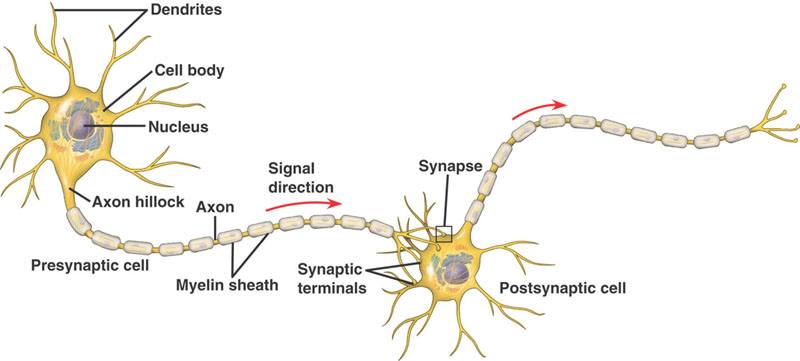
Know the: axon, dendrites. cell body, nodes of Ranvier and the Schwann cells or oligodendrocytes.

15

Slide image

16

17

Multiple Choice

This is the electrical charge that travels down an axon when a neuron is firing
1
Resting Potential
2
Action Potential
3
Threshold
4
Refractory Period

18

Multiple Choice

The tiny gap between neurons where nerve impulses are sent from one neuron to another.  It is where communication occurs between an axon and dendrite
1
synapse
2
axon terminal
3
impulse
4
myelin

19

Multiple Choice

A chemical produced by neurons that carries messages to other neurons
1
myelin sheath
2
neurotransmitter
3
axon
4
axon terminal

20

Multiple Choice

The correct direction of the neural impulse within one neuron.
1
Axon Terminal to Dendrite
2
Dendrite to Axon Terminal
3
Cell Body to Axon
4
Axon Terminal to Cell Body

21

Multiple Choice

The extensions that obtain the messages from other cells are:

1

Myelin Sheats

2

Axon

3

Dendrites

4

Soma

22

Multiple Choice

The extension that transmit electrical impulses from the som to other parts is:

1

Myelin Sheaths

2

Soma

3

Dendrites

4

Axon

23

Multiple Choice

The protective fatty tissue that speeds up the transmission of messages is:

1

Myelin Sheaths

2

Axon

3

Dendrites

4

Soma

24

Multiple Choice

Question image

What is the name of the part of the neuron that is pointed out in the image?

1

Myelin Sheats

2

Cell Body (Soma)

3

Dendrites

4

Axon

25

Multiple Choice

Question image

What is the name of the part of the neuron that is pointed out in the image?

1

Myelin Sheats

2

Axon

3

Dendrites

4

Cell Body (Soma)

26

Multiple Choice

Question image

What is the name of the part of the neuron that is pointed out in the image?

1

Myelin sheaths

2

Cell Body (Soma)

3

Axon

4

Dendrites

27

Multiple Choice

Question image

What is the name of the part of the neuron that is pointed out in the image?

1

Cell Body (Soma)

2

Axon

3

Myelin Sheats

4

Dendrites

28

Multiple Choice

What is the function of the nerve cells?

1

They are responsable of your defense mechanism.

2

They transmit signals or messages to other neurons, organs or glands.

3

They transmit substances to your endocrine system to produce hormones.

29

Action Potentials

An action potential is caused by either threshold or suprathreshold stimuli upon a neuron. It consists of four phases; hypopolarization, depolarization, overshoot, and repolarization. 

An action potential propagates along the cell membrane of an axon until it reaches the terminal button. Once the terminal button is depolarized, it releases a neurotransmitter into the synaptic cleft. The neurotransmitter binds to its receptors on the postsynaptic membrane of the target cell, causing its response either in terms of stimulation or inhibition.

Action potentials are propagated faster through the thicker and myelinated axons, rather than through the thin and unmyelinated axons. After one action potential is generated, a neuron is unable to generate a new one due to its refractoriness to stimuli.


30

31

Steps in an action potential

https://www.britannica.com/science/action-potential

32

Multiple Choice

At what stages do Sodium/Potassium Channels open?
1
Repolarization/ Repolarization
2
Depolarization/ Hyperpolarization
3
Hyperpolarization/ Repolarization
4
Depolarization/ Repolarization

33

Multiple Choice

Why is hyperpolarization important?
1
It makes sure the neuron is healthy
2
It prevents a second, unwanted signal from being sent
3
It makes sure the neurons are in the correct space
4
It makes sure the charge is back at -70 mV

34

Multiple Choice

At what stage does Potassium end outside the neuron, and Sodium ends inside the neuron?
1
Depolarizarion
2
Repolarization
3
Hyperpolarization
4
Resting Potential

35

Multiple Choice

Why is -55 mV a significant number?
1
This is the largest charge achieved during an action potential
2
This is the threshold required to complete an action potential
3
This is the resting charge of a neuron
4
This is the charge when all the sodium is inside the cell

36

Multiple Choice

The sodium-potassium pump....
1
Sends (Na+) into the cell
2
Sends (K+) into the cell
3
Exchanges (K+) & (Na+) during depolarization
4
Exchanges (K+) & (Na+) during hyperpolarization

37

Multiple Choice

Question image
What number on the graph represents the Hyperpolarization phase?
1
1
2
2
3
3
4
4

38

Multiple Choice

Question image
What number on the graph represents the Depolarization phase?
1
1
2
2
3
3
4
4

39

Multiple Choice

Question image
Which ions are involved in the electrical nerve impulse?
1
Iodine and Sodium
2
Potassium and Sodium
3
Iron and Sodium
4
Calcium and Iodine

40

Multiple Choice

When a neuron is not engaged in an impulse.
1
Resting potential
2
Action potential
3
Neural potential
4
Synaptic potential

41

Multiple Choice

When a neuron is resting, the inside of the axon has a ____________ charge.
1
-55 mV
2
-70 mV
3
40 mV
4
-75 mV

42

Multiple Choice

When a neuron is depolarized, what are the first channels to open?
1
Sodium
2
Potassium
3
Calcium
4
ACTH

43

Multiple Choice

Question image
What number(s) on the graph represents the Resting Potential?
1
1 and 2
2
1 and 5
3
2 and 3
4
3 and 4

Nervous System Part 1

Arrangement of the Nervous System, how neurons work, parts of the neuron and action potentials.

Slide image

Show answer

Auto Play

Slide 1 / 43

SLIDE