Search Header Logo
 Checks and Balances Between the Branches

Checks and Balances Between the Branches

Assessment

Presentation

History

8th Grade

Medium

Created by

Darleen Perez

Used 157+ times

FREE Resource

8 Slides • 11 Questions

1

Checks and Balances Between the Branches
Slide image

2


The framers of the Constitution were very concerned about achieving a balance between a strong national government and protection for individual freedoms.  They hoped that dividing the federal government into three branches was one way to limit the government's power.  This  separation of powers  was a key part of the framers' vision of limited government, but what would keep one branch from dominating the others?  As one delegate to the Constitutional Convention pointed out, “From the nature of man, we may be sure that those who have power in their hands .  .  .  will always, when they can .  .  .  increase it. ”

3

separation of powers: a key constitutional principle that divides the functions of government among three branches—legislative, executive, and judicial—to prevent any one branch from gaining too much power

4

Because of this concern, the framers developed a system that would enable each branch of the government to limit the power of the other two branches.  This system is called  checks and balances .


checks and balances: the system that allows each branch of government to limit the powers of the other two branches

5

Checking the Power of Other Branches

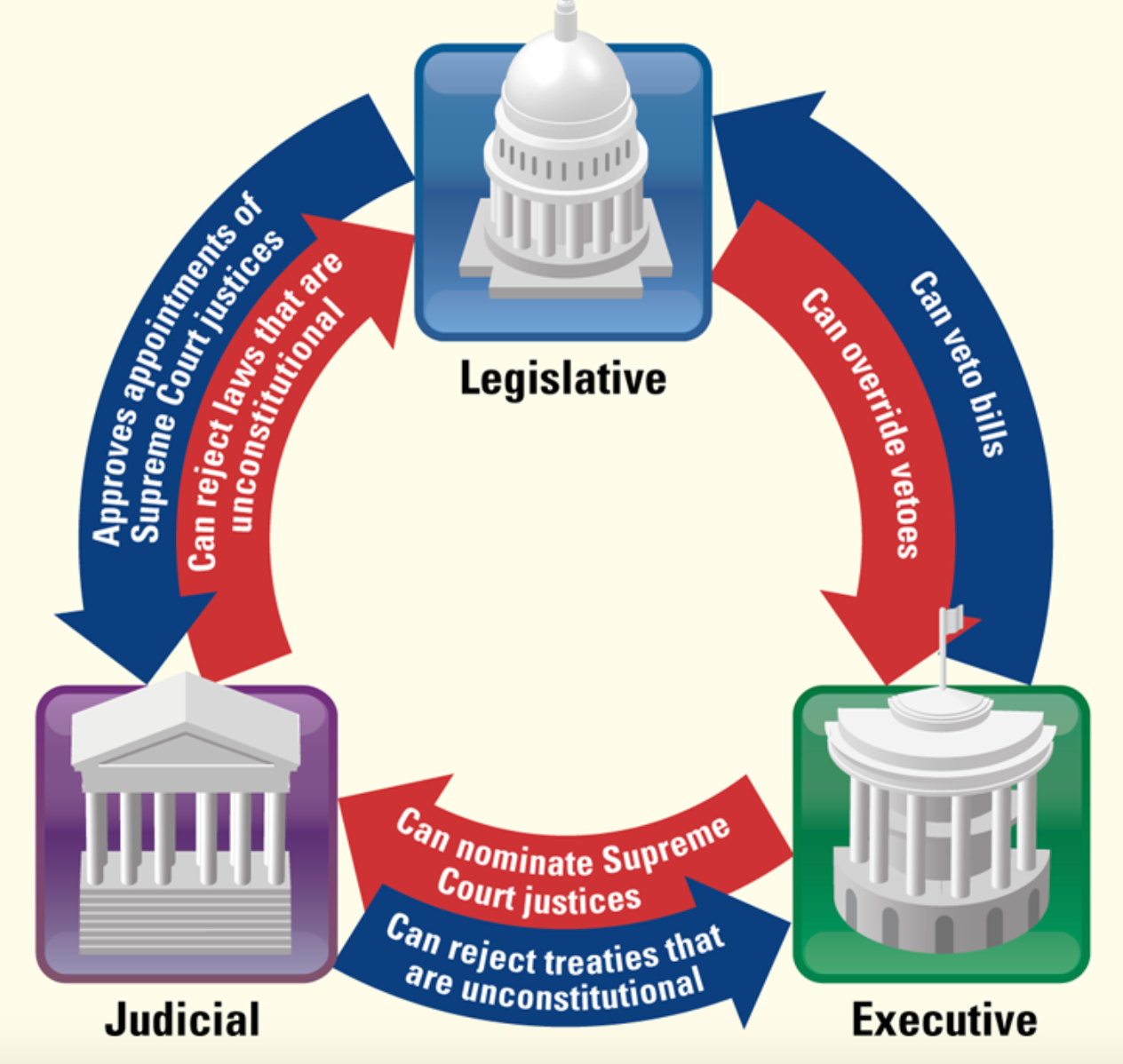
 Checks allow one branch of government to block the actions of another branch. For instance, the president can check Congress's power to pass laws by vetoing a bill before it becomes a law. In turn, Congress can check the president's power by overriding the veto by a two-thirds majority vote in each house.

Similarly, the judicial branch can check the actions of the other two branches through its power of judicial review. The Supreme Court can overturn a law, a treaty, or an executive action if the Court declares that it is unconstitutional.


6

Balancing the Power of Other Branches

 Balances allow each branch of the government to have some role in the actions and power of the other branches. For instance, judges, ambassadors, and cabinet members are appointed only if the president nominates them and the Senate approves the nomination. Similarly, the president has the power to sign treaties, but they take effect only if the Senate approves them.

7


The powers of the judicial branch are also balanced against the powers of the other two branches. Even though the Supreme Court can declare laws unconstitutional, it is the president who chooses federal judges—and the Senate must approve these appointments. In addition, Congress can impeach federal judges. In these ways, the legislative and executive branches have some role in the actions of the judicial branch.


These checks and balances keep any one branch of the federal government from being too strong. This balance of powers is one of the most important features of the U.S. system of government.

8

Multiple Choice

Dividing the federal government into three _____ was a way to limit

the government's power.

1

limit

2

separation of powers

3

branches

4

checks and balances

9

Multiple Choice

Dividing the federal government into three branches was a way to _____

the government's power.

1

limit

2

separation of powers

3

branches

4

checks and balances

10

Multiple Choice

An important part of this

__________ was to maintain a system of checks and balances

. This system is still effective in today's U.S. government.

1

limit

2

separation of powers

3

branches

4

checks and balances

11

Multiple Choice

An important part of this

separation of powers was to maintain a system of ________

. This system is still effective in today's U.S. government.

1

limit

2

separation of powers

3

branches

4

checks and balances

12

Multiple Choice

By separating the functions of government among the three branches, the framers hoped to prevent any one branch from gaining too much power.

1

true

2

false

13

Slide image

14

Multiple Choice

Question image

What branch.. can veto bills

1

Executive

2

Legislative

3

Judicial

15

Multiple Choice

Question image

What branch. can declare executive actions unconstitutional.

1

Executive

2

Legislative

3

Judicial

16

Multiple Choice

Question image

What branch. can declare executive actions unconstitutional.

1

Executive

2

Legislative

3

Judicial

17

Multiple Choice

Question image

What branch. can override vetoes.

1

Executive

2

Legislative

3

Judicial

18

Multiple Choice

Question image

What branch. approves Supreme Court justices.

1

Executive

2

Legislative

3

Judicial

19

Multiple Choice

Question image

What branch. nominates Supreme Court justices.

1

Executive

2

Legislative

3

Judicial

Checks and Balances Between the Branches

Slide image

Show answer

Auto Play

Slide 1 / 19

SLIDE