

HP Unit 06 Review

Presentation
•
Physics
•
9th Grade
•
Hard
+7
Standards-aligned

g Custer
Used 2+ times
FREE Resource
6 Slides • 16 Questions
1
HP Unit 06 Review
2
6-1: Momentum and Impulse
Momentum is the product of an object's mass and velocity.
More mass or a greater velocity means Higher Momentum.
An impulse is any change in momentum.
More force or less time means Greater Impulse.

3
Multiple Choice

If a net force is acting on an object,
4
Multiple Choice

Which of the following has the greatest momentum?
5
Multiple Choice

6
Multiple Choice
7
Multiple Choice

Most modern vehicles have padded dashboards. This reduces collision injuries by...
8
Multiple Choice
9
6-2: Elastic Collisions
Elastic collisions involve objects that hit each other and bounce away from one another.
BOTH momentum and kinetic energy are conserved. The Total Amount stays constant!
No collision is perfectly elastic.

10
6-2: Inelastic Collisions
Inelastic collisions involve objects that hit each other and stick together.
Momentum and Kinetic Energy are NOT conserved, as some energy is transferred into thermal and sound energy.
No collision is perfectly inelastic.

11
Multiple Choice

What makes things happen?
12
Multiple Choice

The picture shows what type of collision?
13
Multiple Choice

Jorge noticed a collision outside the coffee shop where two cars crashed and stuck together. What type of collision did he observe?
14
Multiple Choice
15
Multiple Choice
16
6-3: Kinetic Energy
The energy of motion!
Greater Velocity = More KE
Higher Mass = More KE
A change is Kinetic Energy is defined as Work.

17
6-3: Potential Energy
Stored Energy!
Gravitational: Position
Elastic: Stretchiness
Chemical: Bonds

18
Multiple Choice
19
Multiple Choice
20
Multiple Choice

Steve, Mary, Annie, and James hit four identical tennis balls with a racket. The diagram below shows the top speed at which each tennis ball moved when it was hit.
Based on the diagram, which of the following is true about the tennis balls when they were at their top speed?
21
Multiple Choice
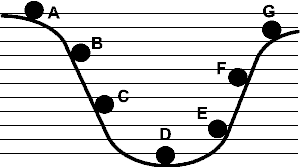
At which point does the ball has the greatest gravitational potential energy (GPE)?
22
Multiple Choice
HP Unit 06 Review
Show answer
Auto Play
Slide 1 / 22
SLIDE
Similar Resources on Wayground

17 questions
Speed and Velocity
Lesson
•
9th Grade
17 questions
Electric Fields and Electric Charge
Lesson
•
9th Grade
18 questions
Introduction to Electricity
Lesson
•
9th Grade
17 questions
Light and sound
Lesson
•
8th Grade
15 questions
Speed
Lesson
•
10th Grade
17 questions
Horizontal and Vertical Lines LIVE
Lesson
•
9th Grade
17 questions
Nutrition - Food Groups
Lesson
•
9th Grade
17 questions
Pedigrees
Lesson
•
9th Grade
Popular Resources on Wayground
15 questions
Fractions on a Number Line

Quiz
•
3rd Grade
10 questions
Probability Practice
Quiz
•
4th Grade
15 questions
Probability on Number LIne
Quiz
•
4th Grade
20 questions
Equivalent Fractions
Quiz
•
3rd Grade
25 questions
Multiplication Facts
Quiz
•
5th Grade
22 questions
fractions
Quiz
•
3rd Grade
6 questions
Appropriate Chromebook Usage
Lesson
•
7th Grade
10 questions
Greek Bases tele and phon
Quiz
•
6th - 8th Grade
Discover more resources for Physics
10 questions
Exit Check 3.3 - Universal Gravitation
Quiz
•
9th Grade
10 questions
Exit Check 3.4 - Moon's Orbit
Quiz
•
9th Grade
10 questions
Exit Check 3.5 - Earth's Orbit
Quiz
•
9th Grade
22 questions
Waves
Quiz
•
KG - University
21 questions
EM Spectrum
Quiz
•
6th - 9th Grade
20 questions
Position vs. Time Graphs
Quiz
•
9th Grade
10 questions
Exploring the Properties of Waves

Interactive video
•
9th - 12th Grade
14 questions
Bill Nye Waves
Interactive video
•
9th - 12th Grade