Search Header Logo
The Bureaucracy TOPIC 2.12

The Bureaucracy TOPIC 2.12

Assessment

Presentation

Social Studies

10th - 12th Grade

Practice Problem

Hard

Created by

David Cruz

Used 17+ times

FREE Resource

27 Slides • 19 Questions

1

The Bureaucracy TOPIC 2.12
Slide image

2

Understandings, objectives, & knowledge

  • ENDURING UNDERSTANDING: The federal bureaucracy implements federal policies.

  • LEARNING OBJECTIVE: Explain how the bureaucracy carries out the responsibilities of the federal government.

  • ESSENTIAL KNOWLEDGE: Tasks performed by departments, agencies, commissions, and government corporations are represented by:

  • Writing and enforcing regulations

  • Issuing fines /Testifying before Congress 

  • Issue networks and “iron triangles”

  • Political patronage, civil service, and merit system reforms all impact the effectiveness of the bureaucracy by promoting professionalism, specialization, and neutrality

3

How the bureaucracy carries out responsibilities

  • The large arm of the executive branch responsible for translating laws into action is called the Federal Bureaucracy.

  • The Federal Bureaucracy is the government means to a public policy end.

  • Federal bureaucrats get frequent criticism and attacks

  • Characterized by its hierarchical organization and specialization

  • The federal bureaucracy is a powerful institution implementing federal policies with sometimes-questionable accountability

  • So big its inefficiency and unresponsiveness sometimes is larger than its size

4

The Federal Bureaucracy Organization

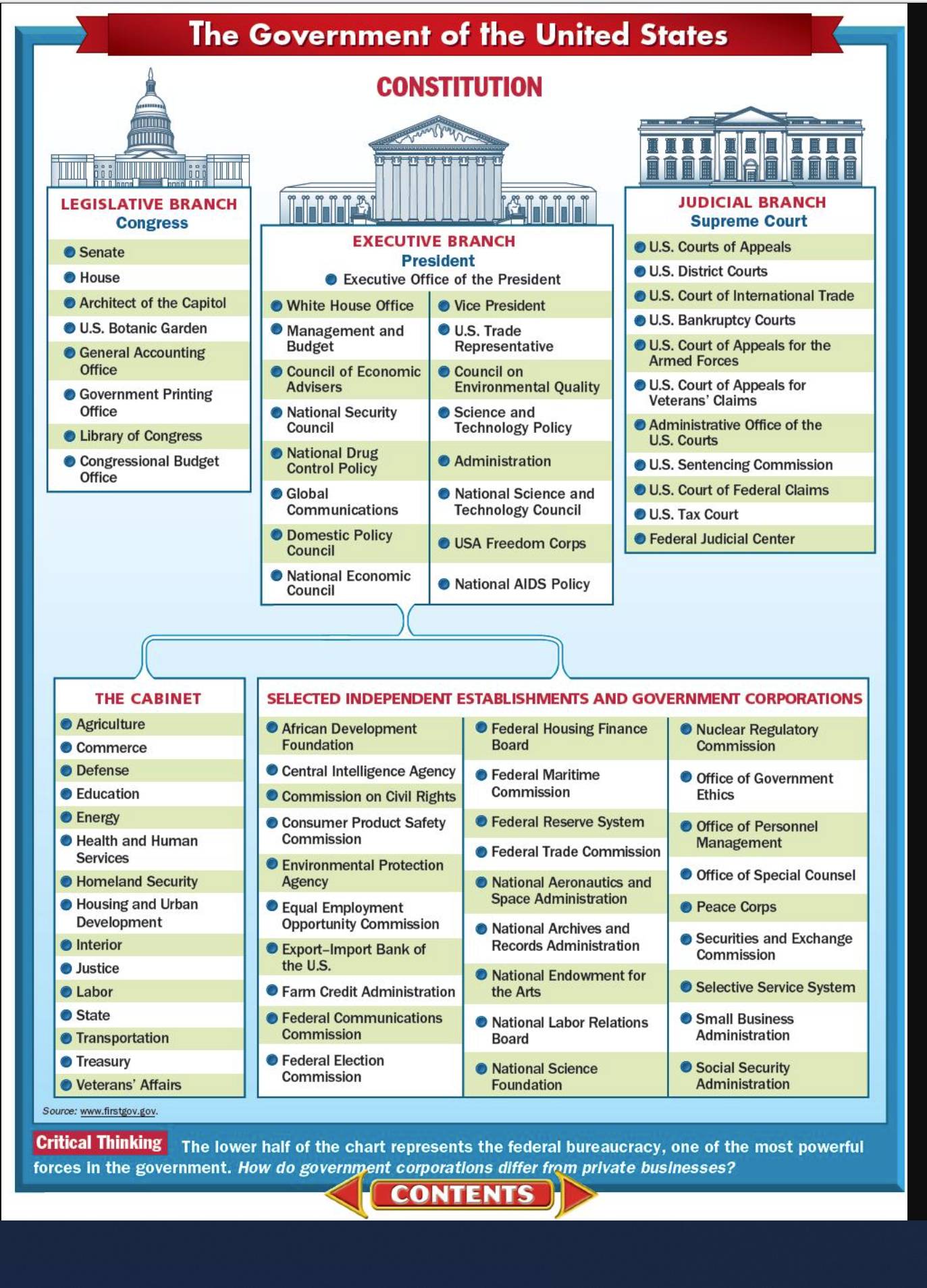
  • Underneath the President of the United States and his White House staff and executive office are the Cabinet Departments.

  •  Today the vast majority of the Federal Bureaucracy is made up of career civil servants.

  • Once  patronage ran appointments –that is by friends and patrons of the president

  •  The Civil Service Act of 1883 established the merit system-Pendleton Civil Service Act (1883)

  • Each Cabinet Department has a head, usually called a Secretary, with multiple levels and layers of responsibility. 

  • In addition to the Cabinet Departments, the Federal Bureaucracy is also made up of Independent agencies like NASA, the CIA and the EPA.

5

Multiple Choice

What is the term for using entrance exams and promotions ratings to get people with talent and skill?

1

civil service

2

government corporations

3

merit principle

4

shareholders

6

Multiple Choice

Question image

Which of the following statements best relates to the information shown in the infographic?

1

Despite many attempts at reform, some members of the federal bureaucracy are still hired through political patronage.

2

Like most businesses, the federal government has to seek out well-qualified and diverse job candidates.

3

Specialized skills, such as a background in STEM, are less important than a degree in political science for most jobs in the bureaucracy.

4

Most members of the federal bureaucracy work near Washington, D.C., or in state capitals.

7

Multiple Choice

What act ended the spoils systems and created the civil service?

1

Pendleton Act 1883

2

Civil Service Reform Act 1883

3

The Hatch Act 1939

4

A and B

8

Slide image

9

Slide image

10

Slide image

11

12

The Federal Bureaucracy Organization

  • In no small way they help to write regulations, enforce existing law and adjudicate disputes

  • The functions of our three branches, from writing, enforcing and interpreting laws, can all be found in the day-to-day operations of the federal bureaucracy.

  • Congress often intentionally passes vague laws. This gives either intended or unintended power to federal bureaucrats who are then left to interpret these laws in the field.

  •  In other words, regulators of the federal government are often given legislative authority. (independent regulatory agency)

  • Example, the Environmental Protection Agency can write rules and regulations that affect and impact air quality

  • For many this is a direct affront on constitutional government. In essence, it is argued, unelected government workers often act without sufficient checks.

13

A veil of a shadow branch??

  • Adjudication of disputes appropriately falls upon our court system

  • The federal bureaucracy exercises more and more judicial authority

  • Outside of normal checks and balances

  • Ex: the Interstate Commerce Commission: are responsible for enforcing laws that govern transportation which often include the regulation of shipping rates. When disputes arise the Commission has the authority to render a decision with the authority of law. (administrative law)

14

A veil of a shadow branch?? (continued)

  • Iron Triangles, or issue networks as they are now called

  •  These are a byproduct of relationships between Congressional committees, related interest groups and specific executive agencies.

  •  Because all three groups share a particular interest they guard specific policies from outsiders

  • Iron Triangles become entrenched in time and help explain why it is so difficult to reduce the size and scope of the national government.

  • This makes it nearly impossible to change specific government policies despite common sense objections.

15

16

Multiple Choice

Question image

Which of the following statements best relates to the information shown in the infographic?

1

Despite many attempts at reform, some members of the federal bureaucracy are still hired through political patronage.

2

Like most businesses, the federal government has to seek out well-qualified and diverse job candidates.

3

Specialized skills, such as a background in STEM, are less important than a degree in political science for most jobs in the bureaucracy.

4

Most members of the federal bureaucracy work near Washington, D.C., or in state capitals.

17

Multiple Choice

Who do the independent executive agencies report to?

1

Congress

2

President

3

Supreme Court

4

the Cabinet

18

Multiple Choice

Who do the independent executive agencies report to?

1

Congress

2

President

3

Supreme Court

4

the Cabinet

19

20

Discretionary and Rule-Making Authority

  • ENDURING UNDERSTANDING :The federal bureaucracy implements federal policies

  • LEARNING OBJECTIVE: Explain how the federal bureaucracy uses delegated discretionary authority for rule making and implementation.

  • ESSENTIAL KNOWLEDGE: Discretionary and rule-making authority to implement policy are given to bureaucratic agencies, including:

  • Department of Homeland Security

  • Department of Transportation

  • Department of Veterans Affairs

  • Department of Education and more

21

So many rules

  • Discretionary authority is an agency's ability to decide whether or not to take certain courses of action when implementing existing laws

  • Rule-making Authority is an agency’s ability to make rules that affect how programs operate, and to force states and corporations to obey these rules as if they were laws.

  • Laws may lack clear, concrete details on how they should be enacted, so the federal bureaucracy has discretionary authority to make decisions on what actions to take—or not take

  • This authority enhances the power of the federal bureaucracy, giving it considerable jurisdiction over the implementation of government policies.

22

Discretionary and rule-making authority EXAMPLES

  • Department of Agriculture can manage favorably controversial ethanol policies

  • Department of Defense can modernize weapon systems

  •  Department of Homeland Security can initiate contentious meta data collections

  •  U.S. Department of Transportation can administer massive infrastructure improvement plans

  • Basically overtime we have seen  the aggrandizement of the federal bureaucracy.

  • But why, We expect more and more from our government. Therefore, our administrative state has expanded its authority.

  • Our federal bureaucracy, at various times, serves as a surrogate for all three branches of government.

23

It does not go unchecked

  • Congressional oversight

  • Investigative journalism ( the media as a watchdog)

  • The Courts (usually SCOTUS)

24

Slide image

25

26

27

Multiple Choice

Bureaucratic rulemaking is best defined as which of the following?

1

the ability to settle debates between states and agencies on how to implement a law

2

the authority to decide how to implement a law and decide Congress’s intention when it passed the law

3

the practice of hiring and promoting individuals based on their qualifications and job performance

4

the power to make legally binding standards that all persons under the agency’s authority must follow

28

Multiple Choice

Which of the following scenarios is an example of a bureaucratic agency using its discretionary authority?

1

The Environmental Protection Agency issues a fine to a company for violations of the Clean Air Act.

2

The Federal Election Commission publishes a report listing every person who donated more than $200 to a campaign.

3

The Department of Education meets with the American Federation of Teachers to discuss policy implementation.

4

The Department of Veterans Affairs sends officials to testify before a congressional committee.

29

Multiple Choice

In 2010, Congress passed the Dodd-Frank Wall Street Reform and Consumer Protection Act, which gave the Securities and Exchange Commission (SEC) more power to regulate and enforce securities laws. In response, the Securities and Exchange Commission created the Office of the Whistleblower, which is responsible for gathering information from people who know of a company committing securities fraud.

The Securities and Exchange Commission’s ability to decide how much money it awards to whistleblowers is an example of which of the following?

1

the relationship between bureaucratic agencies, interest groups, and congressional subcommittees to create public policy

2

the power of bureaucrats to write the specific regulations that determine the implementation of public policy

3

the collaboration between experts and non-experts to influence specific policy outcomes

4

the power that individual bureaucrats and agencies have to make choices about how to implement existing laws

30

Multiple Choice

Congress passed the Clean Air Act, which gave the federal government the power to monitor and limit emissions of harmful chemicals into the atmosphere. However, in 2003, the Environmental Protection Agency (EPA) announced that the Clean Air Act does not give it the authority to regulate carbon dioxide and other greenhouse gases.


The EPA’s decision to not act is an example of which of the following?

1

the relationship between bureaucratic agencies, interest groups, and congressional subcommittees to promote a common cause

2

the collaboration between experts and stakeholders to create specific policy

3

the power that individual bureaucrats and agencies have to make choices about how to implement existing laws

4

the power of bureaucrats to write the specific regulations that determine the implementation of public policy

31

Holding the Bureaucracy Accountable

  • Objectives:

  • Explain how Congress uses its oversight power in its relationship with the executive branch.

  • Explain how the president ensures that executive branch agencies and departments carry out their responsibilities in concert with the goals of the administration.

32

Congress and the Bureaucracy

  • An important duty of Congress is to ensure that executive agencies implement legislation as intended

  • This oversight fulfills Congress’ vital check on the other branches of government.

  • The oversight function of Congress is played out through its power of the purse and through investigative committee hearings. 

  • ****The most pronounced and distinct constitutional authority given to the U.S. Congress is the power of the purse

  • Congress (must start in the House) is granted the power to raise revenue and spend it on public projects that advance democratic interests.

  • Hard to overcome a Clinton and an Obama

  • Presidential ideology, authority, and influence affect how executive branch agencies carry out the goals of the administration

33

National crises

  • War

  • Economic depressions

  • Natural disasters

  • Now Covid

  • It is difficult for Congress to act in one accord

  • Unified v. Divided government

  • Popular exe unpopular exe

34

Controlling the money and the Exe & Bureaucracy

  • In 1974 Congress enacted the Budget and Impoundment Control Act

  • Primary purpose was to restore Congress’ proper place in the federal budgetary

  • The Congressional Budget Office (CBO) was also created to provide independent financial estimates and long-term outcomes for prospective public policies.

  • The Public has demanded from Congress an attempt to reign in fiscal irresponsibility

  • War powers Act1973

  • The power of the purse gives Congress tremendous authority. It should be seen, when used right, as a fundamental means of checking, balancing and limiting the national government.

35

The War Powers Act

  • A congressional resolution designed to limit the U.S. president’s ability to initiate or escalate military actions abroad.

  • Restrictions

  • Reporting within 48 hours then 24-30 days

  • The President must terminate the use of U.S. Armed Forces after 60 days unless Congress has declared war or authorized the action

  • 60 days can be extended for 30 days by the President if he certifies that “unavoidable military necessity respecting the safety of United States Armed Forces”

  • Remove the forces at any time if Congress so directs by concurrent resolution

  • Congress can stop by using power of the purse

36

37

A unitary executive

  • Oversight is only if there is questions arise

  • There are multiple players to consider and assess.

  • Legislation is written in vague terms

  • Congress represents us by not only passing good public policy but also by holding the rest of government accountable.

  • Madison wrote in Federalist 51, “If men were angels, no government would be necessary.” We may not have any angels looking over us, but we certainly need somebody looking over us.

  • Compliance monitoring can pose a challenge to policy implementation.

38

Multiple Choice

What law limits the president's ability to send troops without a declaration of war?
1
War Powers Act
2
War Production Act
3
Military Involvement Act
4
War Involvement Act

39

Multiple Choice

What resolution passed that gave Lyndon Johnson broad powers to defend South Vietnam from communism?
1
Gulf of Tonkin Resolution
2
Gulf of Maddox Resolution
3
USS Tonkin Resolution
4
Gulf of Vietnam Resolution

40

Multiple Choice

What political term describes trading loyalty for jobs and contracts?

1

Spoils System

2

Patronage

3

Malfeasance

4

Graft

41

Multiple Choice

What federal law protects individuals who publicly report government misconduct from being punished?

1

Parkinson’s Law

2

The 2012 Whistleblower Act

3

The 1978 Civil Service Reform Act

4

None of the above

42

Multiple Choice

What type of administrative system was used prior to the establishment of meritocracy in the federal bureaucracy?

1

The spoils system

2

Nepotism

3

The Pendelton system

4

None of the above

43

Multiple Choice

What are the broad social purposes of bureaucracies?

1

To implement public policy

2

To grow as much as possible to offset and regulate capitalism

3

To impose order and stability in society

4

None of the above

44

Poll

Today's lesson was

objective driven

followed the AP Curriculum

Understandable

needs help

45

Multiple Select

Today's lesson covered

1

Holding the Bureaucracy Accountable

2

Holding Congress accountable

3

Power of the purse

4

War powers act

46

Open Ended

I can at least answer one OBJECTIVE:


Explain how the bureaucracy carries out the responsibilities of the federal government.


Explain how Congress uses its oversight power in its relationship with the executive branch.


Explain how the president ensures that executive branch agencies and departments carry out their responsibilities in concert with the goals of the administration.

The Bureaucracy TOPIC 2.12

Slide image

Show answer

Auto Play

Slide 1 / 46

SLIDE