
- Resource Library
- Social Studies
- History
- Inca Civilization
- Pre Colonization Of Central & South America Lesson

Pre-Colonization of Central & South America Lesson

Presentation
•
Social Studies
•
6th Grade
•
Practice Problem
•
Easy

Crystal Mouton
Used 62+ times
FREE Resource
3 Slides • 10 Questions
1
Pre-Colonization of Central & South America Lesson
2
DO NOW
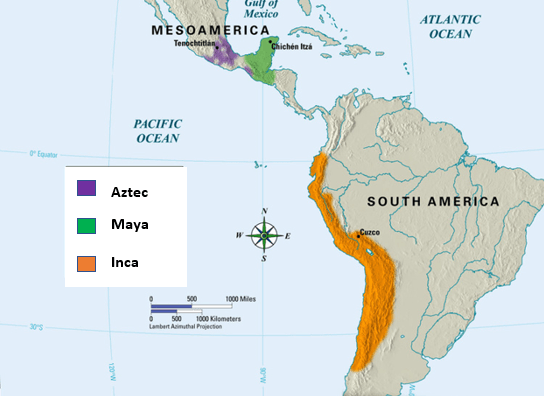
The map below shows the locations of three Latin American cultures (The Aztecs, Mayans, and Incas). Use the information in the map to answer the following questions.
3
Poll

Identify the ocean which borders the land of ALL THREE cultures.
4
Multiple Select

Identify the cultural group(s) located in Mesoamerica.
5
Multiple Choice

Identify the cultural group(s) located in South America.
6
Pre-Colonization of Central & South America
By the end of this lesson you will be able to understand various Central & South America cultures during the pre-colonization period.

7
Open Ended

The Mayan Culture
Mayan culture was established by 1000 BCE. The Maya lived in an area of the Yucatan Peninsula that had poor, infertile soil and no large rivers. Not ideal conditions for a successful civilization. Yet its people grew corn, beans, squash, peppers, and cacao (chocolate). Farming was really important to the Mayas. Most people grew their own crops in small fields. If farmers grew more than they could eat, they traded the leftovers in markets.
Identify foods that were a part of the Mayan culture.
Sentence Stem: The foods that were a part of the Mayan culture were...
8
Open Ended

We know a lot about the Maya because they had an advanced writing system. Mayan writing included both pictographs and symbols for syllables. Scholars have made great progress in translating the language. Though few books have survived, there are many carved monuments and pottery that include Mayan languages.
What was unique about the written Mayan language?
Sentence Stem: Something interesting about the Mayan language was...
9
Open Ended

The Maya believed that all natural objects, such as trees and rocks, were inhabited by spirits with invisible powers. They worshipped a range of gods who could change themselves into human and animal shapes. Priests performed ceremonies to keep the gods happy. The Maya thought the world was divided into three parts the Heavens, the Earth and the Underworld, which were all linked together by a giant World Tree. Mayan kings were also thought to become gods after death.
Explain which type of religion the Mayans practiced.
Criteria for Success:
· Identify the type of religion.
· Describe what that type of religion means.
· Explain how you know that the Mayans practiced that type of religion by providing text evidence.
Sentence Stem: The type of religion the Mayan’s followed was.... which means....
The evidence from the text says...
10
Open Ended

The Aztec Culture
Mexica (me-SHI-ka) people, better known as Aztecs, came from northern Mexico. They settled on an island in a large lake in the Valley of Mexico in 1325. They built the city of Tenochtitlan (the-noch-tee-TLAHN), or "place of the cactus fruit." This is the area where Mexico City now stands. By the early 1500s, the Aztecs had conquered most of Mesoamerica (the region of Mexico and Central America). They ruled about 11 million to 12 million people.
Describe the physical features of the land that the Aztecs settled on.
Sentence Stem: The physical features of the land the Aztec settled on was...
11
Multiple Select

Identify examples of food from the Aztec culture.
12
Open Ended

The Aztec spoke a language called Nahuatl. The Aztec had no alphabet of their own, but they used picture writing to record their history. Only the priests knew how to read and write. They would write on long sheets made of animal skins or plant fibers. An Aztec book is called a codex.
Describe the Aztec written language.
Sentence Stem: The Aztec language can be described as...
13
Multiple Choice

The Aztecs had many gods but worshipped Huitzilopochtli, the god of sun and war, above all others. The Aztecs called themselves the "People of the Sun". They felt that in order for the sun to rise each day the Aztecs needed to perform rituals and sacrifices to give the sun strength. Human and animal sacrifice was a religious ritual for the Aztecs. The priests performed sacrificial ceremonies in temples. Other gods included Tlaloc, the god of rain and water, and Quetzalcoatl, god of life and wind. While Tlaloc helped the Aztecs much of the time by sending rain and causing plants to grow, he also could get angry and send thunderstorms and hail.
Select which type of religion the Aztec practiced.
Pre-Colonization of Central & South America Lesson
Show answer
Auto Play
Slide 1 / 13
SLIDE


