
Energy Flow in Ecosystems-Day 3
Presentation
•
Science
•
6th Grade
•
Practice Problem
•
Medium
+2
Standards-aligned
Jordan Yager
Used 9+ times
FREE Resource
16 Slides • 17 Questions
1
Limiting Factors and Carrying Capacity
2
Learning Target
I can investigate limiting factors, carrying capacity, and exponential growth to a population and represent these terms graphically.
I can identify and determine the cause and effect relationships between resources and the numbers of organisms in ecosystems during periods of abundant and scarce resources.
3
4
5
Multiple Choice
6
Multiple Choice
7
Multiple Choice
8
Multiple Choice
9
10
Multiple Choice
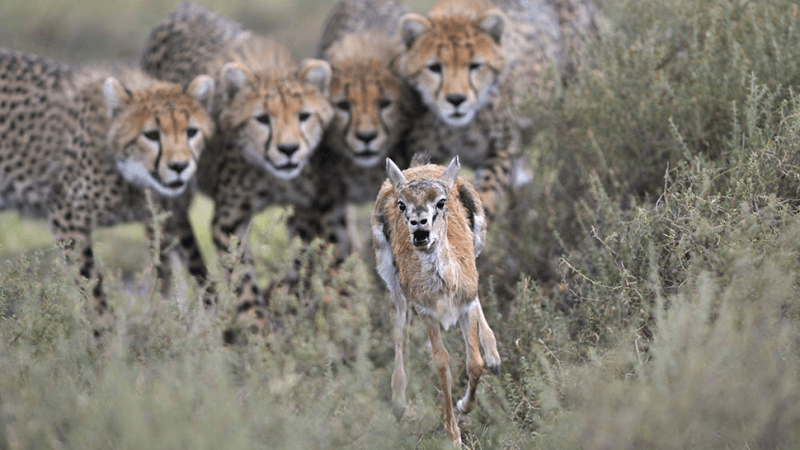
Hawks and owls eat the same type of food and struggle with one another to get their food. What is this an example of?
Competition
Biotic factor
Symbiosis
Population
11
Multiple Choice
12
13
Multiple Choice
If a disease strikes the snake population in the food chain shown, what will be the initial effect on the populations of hawks and rabbits?
The populations of hawks and rabbits will decrease.
The populations of hawks and rabbits will increase.
The population of hawks will increase. The population of rabbits will decrease.
The population of hawks will decrease. The population of rabbits will increase.
14
15
16
17
18
19
Multiple Choice
20
Multiple Choice
In Predator/Prey Graphs what happens to Predator numbers if Prey numbers increase.
The predator numbers INCREASE
The predator numbers DECREASE
21
Multiple Choice
In a meadow ecosystem, a population of rabbits increases. What populations are most likely to increase as a result?
foxes, hawks, and other predators of the rabbits
leafy plants that rabbits eat
rabbits that live elsewhere
worms that live in the meadow soil
22
23
24
25
Multiple Choice
In an ecosystem, snakes feed on frogs, which feed on mosquitoes. Use of a bug spray has decreased the number of mosquitoes. What will probably happen to the number of frogs and snakes?
Frogs will increase, snakes will increase
Frogs will increase, snakes will decrease
Frogs will decrease, snakes will increase
Frogs will decrease, snakes will decrease
26
27
28
Multiple Choice
When birth rate is high and death rate is low...
population increases
population decreases
population stays the same
all of these
29
Multiple Choice
When the death rate rises and the birth rate lowers...
population increases
population decreases
population stays the same
all of these
30
Multiple Choice
When death rate is equal to birth rate...
population increases
population decreases
population stays the same.
population rapidly increases then becomes stable
31
Multiple Choice
Something that regulates the size of a population is called...
a limiting measure
a limiting factor
carrying capacity
biodiversity
32
Multiple Choice
This may cause a population to increase
increase of food supply
removal of predators
removal of disease
all of these
33
Multiple Choice
What happens if a population grows past its carrying capacity?
The population keeps growing
The population starts to die off
The entire species will go extinct
The carrying capacity just increases
Limiting Factors and Carrying Capacity
Show answer
Auto Play
Slide 1 / 33
SLIDE

Similar Resources on Wayground
25 questions
Characteristics and Properties of Waves Review
Presentation
•
6th Grade
23 questions
Asteroids, Meteors, and Comets
Presentation
•
6th Grade
27 questions
Volcano Formation
Presentation
•
5th Grade
26 questions
Forms of Energy Lesson
Presentation
•
6th Grade
25 questions
Erosion and Deposition
Presentation
•
6th Grade
25 questions
Unit 2 Metals, Nonmetals, and Metalloids Lesson
Presentation
•
6th Grade
27 questions
What makes water a unique liquid?
Presentation
•
6th Grade
29 questions
Cell Analogies
Presentation
•
6th Grade
Popular Resources on Wayground
10 questions
5.P.1.3 Distance/Time Graphs
Quiz
•
5th Grade
10 questions
Fire Drill
Quiz
•
2nd - 5th Grade
20 questions
Equivalent Fractions
Quiz
•
3rd Grade
22 questions
School Wide Vocab Group 1 Master
Quiz
•
6th - 8th Grade
20 questions
Main Idea and Details
Quiz
•
5th Grade
20 questions
Context Clues
Quiz
•
6th Grade
20 questions
Inferences
Quiz
•
4th Grade
12 questions
What makes Nebraska's government unique?
Quiz
•
4th - 5th Grade
Discover more resources for Science
19 questions
Introduction to Properties of Waves
Presentation
•
6th - 8th Grade
16 questions
Interactions within Ecosystems
Presentation
•
6th - 8th Grade
10 questions
Exploring the Layers of the Earth
Interactive video
•
6th - 10th Grade
15 questions
Punnett Squares
Quiz
•
6th Grade
20 questions
Energy Transformations
Quiz
•
6th - 8th Grade
20 questions
Cell Organelles and Functions
Quiz
•
6th - 8th Grade
10 questions
Ecosystem levels of organization
Quiz
•
6th Grade
20 questions
Levels of Organization
Quiz
•
6th Grade