
U2L4: Plant Reproduction
Presentation
•
Science
•
7th Grade
•
Medium
Standards-aligned
Katherine McDonald
Used 21+ times
FREE Resource
10 Slides • 7 Questions
1
U2L4: Plant Processes
Plant Reproduction
2
What are the phases of a plant’s life cycle? - pg 124
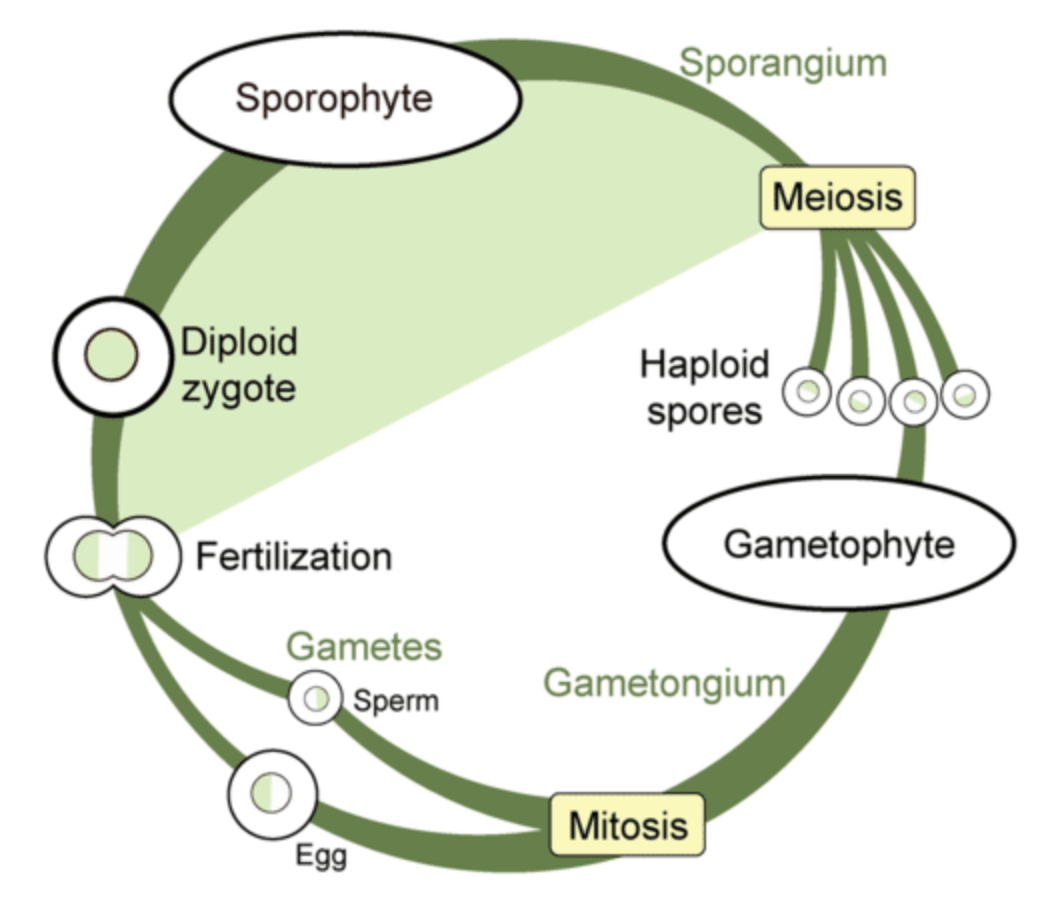
All plants complete their life cycle by alternating between two phases: the sporophyte and the gametophyte.
In one phase, plants called sporophytes produce spores by meiosis. The spores are then released.
Meiosis is a process of cell division in which each daughter cell receives half the chromosomes of the parent cell.
3
Under the right conditions, spores grow into plants called gametophytes.
Female gametophytes make eggs and male gametophytes make sperm.
When a sperm fertilizes an egg, they form an embryo, which develops into a seed. The seed is released and can grow into a new sporophyte.
4
5
Multiple Select
What are the 2 phases of a plant's life cycle called? Make sure you choose 2 options!!
gametophyte
sporophyte
spores
gametes
6
How do seedless plants reproduce? - pg 125
In seedless plants, sperm, which have tails & swim to eggs to fertilize them, are released in the presence of water.
The fertilized eggs grow into sporophytes.
Some seedless plants, have a visible gametophyte phase.
7
Multiple Choice
What do seedless plants produce for reproduction?
gametes
seeds
cones
spores
8
How do seed plants reproduce? - pg 125
In most seed plants, the sporophyte makes two types of spores, male and female, that grow into microscopic male and female gametophytes.
The male gametophyte is pollen, a tiny structure where sperm forms, which can be carried by wind, water, or animals.
The female gametophyte produces eggs. Pollination happens when pollen lands on and fertilizes the female plant reproductive structure.
9
Multiple Choice
In seed producing plants, what is the structure called that produces the male cell - sperm?
sepal
pollen
spore
pistil
10
How do flowering plants reproduce? - pg 126
Flowers are reproductive structures with specialized leaves called sepals and petals, which can attract animal pollinators such as insects.
A stamen is the male reproductive structure of flowers. At the tip of each is an anther, where pollen is produced.
A pistil is the female reproductive structure of flowers. When pollen reaches the tip of a pistil, called the stigma, pollination occurs.
11
Multiple Choice
What is the structure in the circle called?
ovary
filament
pistil
anther
12
Multiple Choice
What is the structure in the rectangle called?
ovary
filament
pistil
anther
13
A pollen tube grows down the pistil into the ovary, where one or more ovules contain eggs.
Sperm travel into the ovary & fertilize the eggs, which develop an embryo: a tiny, undeveloped plant.
The ovule develops into a seed that surrounds and protects the embryo. The ovary becomes a fruit, which protects the seeds and helps them spread.
14
Multiple Choice
Which happens first?
sperm fertilizes the egg
the ovule grows into a seed to protect the embryo
pollen lands on pistil & travels down pollen tube.
the ovary grows into a fruit to protect the seed
15
How do plants reproduce asexually? - pg 127
Asexual reproduction allows a plant to reproduce without seeds or spores. Part of a parent plant, such as a stem or root, produces a new plant.
Plantlets, tubers, and runners are examples of structures that plants use to reproduce asexually.
16
Plantlets grow on the edges of a plant’s leaves. They fall off and grow on their own.
Tubers, such as a potato, are underground stems that store nutrients and grow into a new plant.
Runners, such as strawberries, are above-ground stems that can grow into new plants.
17
Multiple Choice
Which of the following is an example of a runner?
U2L4: Plant Processes
Plant Reproduction
Show answer
Auto Play
Slide 1 / 17
SLIDE

Similar Resources on Wayground
12 questions
Qualitative vs Quantitative Observations
Lesson
•
7th Grade
12 questions
Biotechnology - GMO - 1/5/2020
Lesson
•
6th - 7th Grade
15 questions
Listening to Earth
Lesson
•
7th Grade
12 questions
Geologic Time
Lesson
•
7th Grade
9 questions
The Immune System
Lesson
•
7th Grade
12 questions
Revisit: Volcanos!
Lesson
•
7th Grade
12 questions
Living Things
Lesson
•
KG
13 questions
Frog Dissections
Lesson
•
7th Grade
Popular Resources on Wayground
10 questions
5.P.1.3 Distance/Time Graphs
Quiz
•
5th Grade
10 questions
Fire Drill
Quiz
•
2nd - 5th Grade
20 questions
Equivalent Fractions
Quiz
•
3rd Grade
15 questions
Hargrett House Quiz: Community & Service
Quiz
•
5th Grade
20 questions
Main Idea and Details
Quiz
•
5th Grade
20 questions
Context Clues
Quiz
•
6th Grade
20 questions
Inferences
Quiz
•
4th Grade
15 questions
Equivalent Fractions
Quiz
•
4th Grade
Discover more resources for Science
19 questions
Introduction to Properties of Waves
Lesson
•
6th - 8th Grade
16 questions
Interactions within Ecosystems
Lesson
•
6th - 8th Grade
10 questions
Exploring the Layers of the Earth
Interactive video
•
6th - 10th Grade
20 questions
Electricity and Circuits
Quiz
•
7th Grade
16 questions
Photosynthesis and Cellular Respiration Review
Quiz
•
7th Grade
8 questions
VP #9: Amoeba Sisters Pedigrees
Interactive video
•
7th Grade
15 questions
Mitosis Amoeba Sister Video
Interactive video
•
7th Grade
20 questions
Food Webs + Energy Pyramids
Quiz
•
7th Grade