Search Header Logo
Unit 4 Review AP Bio

Unit 4 Review AP Bio

Assessment

Presentation

Biology, Science

11th - 12th Grade

Practice Problem

Medium

NGSS
HS-LS1-4, HS-LS1-3

Standards-aligned

Created by

Ariella Scott

Used 607+ times

FREE Resource

11 Slides • 7 Questions

1

Unit 4 Review AP Bio

Fall 2020

Slide image

2

Topics covered on the test

  • Cell communication (why cells communicate, long vs. short distance signaling)

  • Signal Transduction Pathways

  • The Cell Cycle and Mitosis

  • Regulation of the Cell Cycle

  • Feedback Loops (positive and negative)

3

Feedback Loops

  • Negative and positive feedback

  • Negative feedback loops: figure 8 shaped, used to bring conditions back to set point (maintains homeostasis)

  • Ex: temperature regulation, blood sugar, osmolarity

  • Positive feedback loops: circle shaped, simulus reinforces response and response in turn amplifies stimulus

  • Ex: fruit ripening, child birth

4

Practice Question

This diagram represents the feedback loop that controls thyroid function in humans. 


If someone were to have their thyroid gland surgically removed, what effect would it have on this feedback loop?

Slide image

5

Multiple Choice

When a blood vessel is damaged, platelets will rush to the site of damage and adhere to the vessel beginning the formation of a blood clot. These platelets will then release a chemical into the bloodstream, which recruits even more platelets to rush to the site of damage. As more platelets accumulate, more of the signaling chemical is released into the blood. This process will end when the blood has been sufficiently clotted and active bleeding is no longer occurring. What type of feedback loop is blood clotting an example of?

1

Negative Feedback Loop

2

Positive Feedback Loop

6

Cell Communication

  • Cells can communicate over long and short distances

  • Short distance (aka local signaling): signaling molecule travels to nearby cells without the help of the bloodstream

  • Types of local signaling: cell junctions, synaptic signaling, paracrine signaling

  • Long distance (aka endocrine signaling): signaling molecules are called hormones and must travel through the bloodstream to reach target cells

  • Cells only have receptors for ligands they interact with

7

Multiple Choice

A protein called Sonic Hedgehog plays a key role in vertebrate embryonic development. When this protein is released by secretory cells, it travels through the extracellular fluid and signals adjacent cells to go through the process of cell differentiation (process of cells becoming specialized). Sonic hedgehog is thought to be especially important for the development of the brain and limbs. What type of signaling is this an example of?

1

Synaptic Signaling (Local)

2

Paracrine Signaling (Local)

3

Endocrine Signaling (Long Distance)

8

Multiple Choice

Adjacent plant cells have narrow channels called plasmodesmata that pass through the cell walls of the connected cells and allow a cytoplasmic connection between the cells.

Which of the following statements best describes a primary function of plasmodesmata?

1

They allow the movement of molecules from one cell to another, enabling communication between cells.

2

They prevent the cell membrane from pulling away from the cell wall during periods of drought.

3

They eliminate the need to produce signaling molecules and eliminate the need for cells to have receptors for signaling molecules.

4

They increase the surface area available for attachment of ribosomes and thus increase protein synthesis.

9

Signal Transduction Pathways

  • Reception -> Transduction -> Response

  • If one step is disrupted, everything downstream of that step will be disrupted as well (chain of dominos)

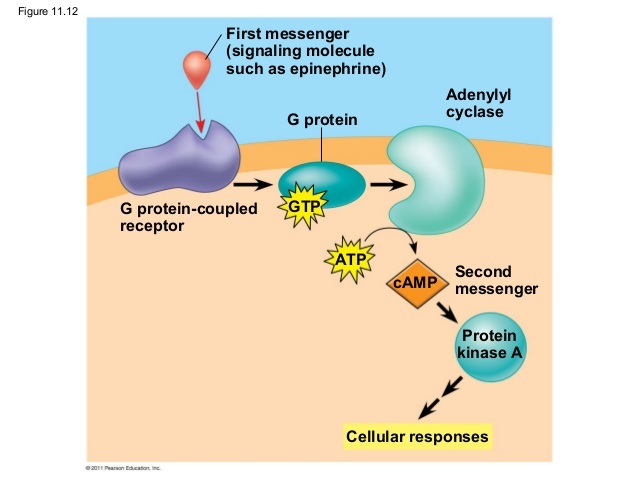
  • Reception: Ligand binds at a receptor. This receptor is usually on the surface of the cell (ex: GPCR and LGIC) or can be inside the cell (intracellular receptor)

  • Transduction: often involves a second messenger molecule (ex: cAMP), enzymes, and phosphorylation cascade

  • Reponse: can vary but often involves turning a gene on/off, activating an enzyme or protein channel, starting cell division

10

GPCR pathway involving cAMP

Slide image

11

Multiple Choice

Which of the following correctly matches the molecule with its normal function in a signal transduction pathway?

1

Adenylyl cylase: converts cAMP into ATP

2

Protein kinase: transports phosphate groups in and out of the cell

3

Protein phosphatase: dephosphorylates (removes phosphate groups from) proteins

4

cAMP: acts as a second messenger to activate G protein coupled receptors (GPCRs)

12

Multiple Choice

Epinephrine is a protein hormone found in many animals. Epinephrine stimulates a signaling pathway that results in the breakdown of glycogen to glucose in the liver cells. Which of the following describes the initial steps in the process whereby epinephrine stimulates glycogen breakdown?

1

Epinephrine binds to a cell-surface receptor; the activated receptor stimulates production of the second messenger, cAMP.

2

Epinephrine binds to a cell-surface receptor; the activated receptor catalyzes the conversion of glycogen to glucose.

3

Epinephrine diffuses through the plasma membrane; the hormone dimerizes in the cytosol.

4

Epinephrine is taken into the cell by endocytosis; glycogen is converted to glucose in the endocytotic vesicle.

13

Cell Cycle

  • Cell cycle is made up of two phases: interphase and mitotic (m) phase

  • Interphase can be further broken into G1, S, G2

  • Mitotic phase can be further broken down into mitosis and cytokinesis

  • Mitosis can be further broken down into PMAT

14

Cell Cycle- DNA/Chromosomes

  • DNA will be in the form of chromosomes during the process of cell division

  • At all other points, DNA will be in the form of chromatin

  • Chromosomes are made up of chromatin, which is made up of DNA wound around histone proteins

  • Chromosomes can be made up of one or two chromatids. Sister chromatids are held together by a centromere

15

Multiple Choice

A researcher examining a root tip observes a plant cell with condensed sister chromatids, kinetochores with attached microtubules, and individual chromosomes that are aligned at the equatorial plate of the cell. Which of the following best describes what the next process will be in the cell?

1

Homologous chromosomes (each with two sister chromatids) will move toward opposite poles of the cell.

2

Paired chromatids will separate, and the new daughter chromosomes will move toward opposite poles of the cell.

3

The nuclear envelope will break down, and the spindle will begin to form.

4

The chromatin will decondense, and the daughter cell will enter interphase.

16

Regulation of the Cell Cycle

  • Cells pass checkpoints as they move through the cell cycle

  • Cyclins and cyclin dependent kinases help to regulate movement of cells through the cell cycle and ensure cells do not divide too frequently

  • If a cell acquires a mutation in a protein that is responsible for regulating the cell cycle, it may begin to divide uncontrollably

  • Unregulated cell division can lead to the formation of tumors which can be benign or cancerous

17

Slide image

18

Multiple Choice

Cyclin dependent kinases are activated by their associated cyclin proteins. At the G1 checkpoint, activated CDKs signal the cell to continue on to DNA Synthesis (S phase). p53 is a protein that acts as a CDK inhibitor, blocking the action of CDK and preventing cells from continuing on to the S phase if their DNA is damaged. If a cell acquires a mutation which inactivates p53, how will it likely affect the cell cycle?

1

Cells with DNA damage will move through the cell cycle more slowly resulting in slower wound healing

2

Cells with damaged DNA will progress through the cell cycle, resulting in the potential development of a cancerous tumor

3

Cells with damaged DNA will no longer be able to divide and will be sent to the G0 phase

4

Another protein will take over the role of p53 and the cell cycle will proceed normally

Unit 4 Review AP Bio

Fall 2020

Slide image

Show answer

Auto Play

Slide 1 / 18

SLIDE