Sequences of Transformations (Rigid Motions)
Presentation
•
Mathematics
•
8th - 10th Grade
•
Hard
Standards-aligned
Jan Cox
Used 308+ times
FREE Resource
6 Slides • 5 Questions
1
Sequences of Transformations (Rigid Motions)
2
Properties of Sequences of Rigid Motions
Size and shape stay the same.
Angle measures stay the same.
Area and perimeter stay the same.
Parallel segments or lines stay parallel.
Pre-image and image are congruent.
3
Sequences...
Sequences of transformations are performed by doing each transformation in the order listed. Perform the first transformation on the pre-image and each transformation after that on the image created by the previous transformation.
4
Example
The blue trapezoid is translated 4 units right and then reflected over the x-axis to form the red trapezoid.
5
Example
Square ABCD is rotated 90° counterclockwise and then reflected over the y-axis to form square A'B'C'D'.
6
Example
Triangle ABC is rotated 180° about the origin, translated 5 units down, and then reflected over the x-axis to form ∆A'B'C'.
7
Multiple Choice
What sequence of transformations maps the red parallelogram to the green parallelogram?
A translation followed by a reflection.
A rotation followed by a translation.
A reflection followed by a translation.
A reflection followed by a rotation.
8
Multiple Choice
Which sequence could be used to transform hexagon C to hexagon D?
Translation 4 left and 2 down
a reflection over the x-axis and a translation 6 units right
a reflection over the y-axis and a translation 2 units down
a counter-clockwise rotation of 90 degrees about the origin
9
Multiple Choice

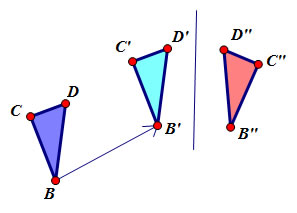
What sequence of transformations will get you from the blue triangle BCD to the red triangle B"C"D"?
Rotation, then Rotation
Rotation, then Dilation
Reflection, then Rotation
Translation, then Reflection
10
Multiple Choice
What sequence of transformations could map triangle ABC to triangle A"B"C"?
A dilation followed by a rotation.
A translation followed by a reflection.
A rotation about the origin followed by a translation.
A reflection followed by a rotation.
11
Multiple Choice
Which of the following describes the sequence of transformations shown?
Reflection followed by a rotation.
Rotation followed by a translation.
Reflection across the x-axis followed by a reflection across the y-axis.
Translation followed by a rotation.
Sequences of Transformations (Rigid Motions)
Show answer
Auto Play
Slide 1 / 11
SLIDE

Similar Resources on Wayground
10 questions
Parallel and perpendicular slope
Lesson
•
9th Grade
8 questions
A-CED Questions
Lesson
•
8th - 10th Grade
12 questions
Special Right Triangles
Lesson
•
8th - 10th Grade
10 questions
geometry unit 4, classifying triangles
Lesson
•
8th - 10th Grade
9 questions
Geometric Mean
Lesson
•
9th - 10th Grade
9 questions
Graphing Functions
Lesson
•
8th - 9th Grade
9 questions
Geometric Sequences
Lesson
•
8th - 9th Grade
10 questions
The Discriminant
Lesson
•
9th Grade
Popular Resources on Wayground
10 questions
5.P.1.3 Distance/Time Graphs
Quiz
•
5th Grade
10 questions
Fire Drill
Quiz
•
2nd - 5th Grade
20 questions
Equivalent Fractions
Quiz
•
3rd Grade
15 questions
Hargrett House Quiz: Community & Service
Quiz
•
5th Grade
20 questions
Main Idea and Details
Quiz
•
5th Grade
20 questions
Context Clues
Quiz
•
6th Grade
20 questions
Inferences
Quiz
•
4th Grade
15 questions
Equivalent Fractions
Quiz
•
4th Grade
Discover more resources for Mathematics
15 questions
Pythagorean Theorem Word Problems Quizizz
Quiz
•
8th Grade
20 questions
Graphing Inequalities on a Number Line
Quiz
•
6th - 9th Grade
10 questions
Exploring Basic Probability Concepts
Interactive video
•
6th - 10th Grade
73 questions
Math 8 Benchmark Review
Quiz
•
8th Grade
20 questions
Pythagorean Theorem Review
Quiz
•
8th Grade
25 questions
Linear vs Nonlinear Functions
Quiz
•
8th Grade
20 questions
Surface Area of Rectangular Prisms
Quiz
•
8th Grade
11 questions
Adding and Subtracting Polynomials
Quiz
•
9th Grade