
Plant and Animal Cell Tonicity
Presentation
•
Biology
•
9th - 12th Grade
•
Practice Problem
•
Medium
Standards-aligned
Hannah Schuerman
Used 715+ times
FREE Resource
7 Slides • 7 Questions
1
Plant and Animal Cell Tonicity
Let's explore what happens to plant and animal cells in different solutions!
2
Tonicity Review
There are three different types of solutions: hypertonic, isotonic, and hypotonic.
Don't forget that when solutions of different concentrations are separated by a membrane permeable to water, the water will move from the side with lower concentration to the side with higher concentration.
3
Take a closer look...
When the concentration on the INSIDE of the cell is higher, the water will move into the cell, causing the cell to swell. (Hypotonic)
When the concentration on the OUTSIDE of the cell is higher, the water will move out of the cell, causing the cell to shrink. (Hypertonic)
When the concentration on the inside of the cell is the SAME as the outside, the water will move in and out of the cell, causing no change to the cell. (Isotonic)
4
Here are the three types of solutions!
5
But what do plant and animal cells look like when they are put in different solutions?
Let's find out!
6
Animal Cells
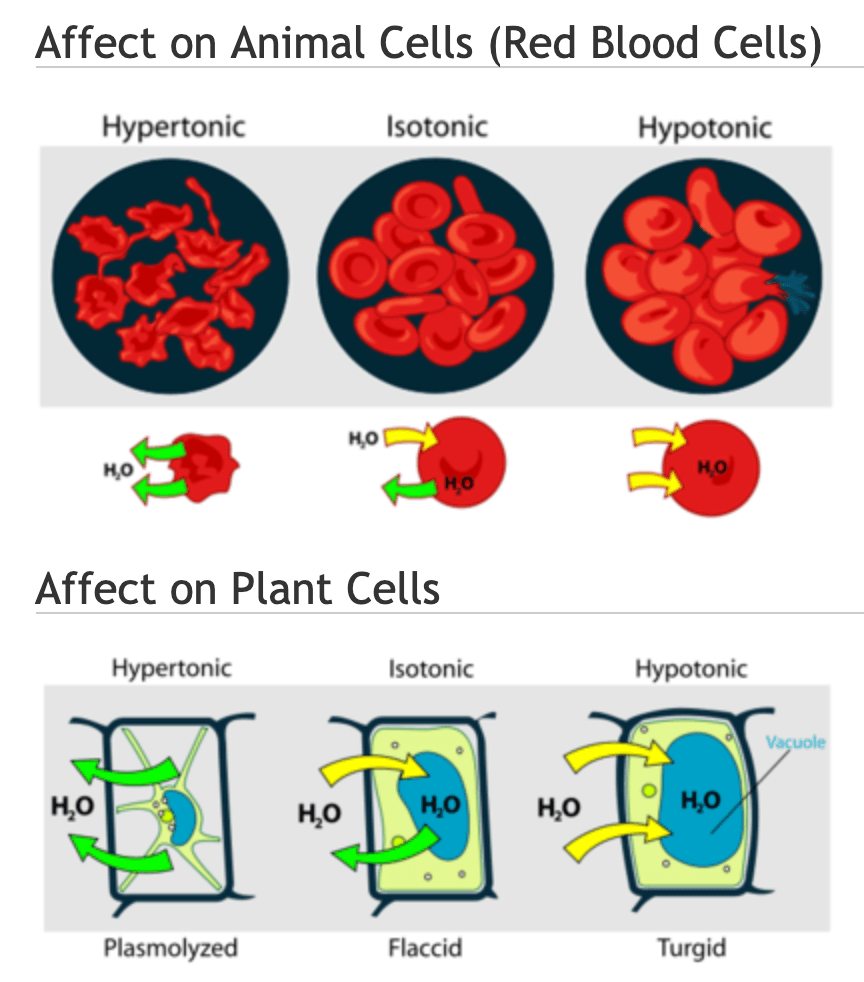
A hypertonic solution causes water to move out of the cell and the cell becomes shriveled. Red blood cells develop a star-shaped appearance that resembles a spiked ball (they become crenated).
An isotonic solution does not result in any net movement of water in/out of the cell and so it remains unaffected.
A hypotonic solution causes water to move into the cell. Animal cells do not have a tough cellulose wall and if water continues to move into the cell pressure builds until ultimately the cell bursts (cell lysis)
7
Multiple Choice
Which picture below shows an animal cell, like a red blood cell, that has been placed in a Hypotonic Solution?
8
Plant Cells
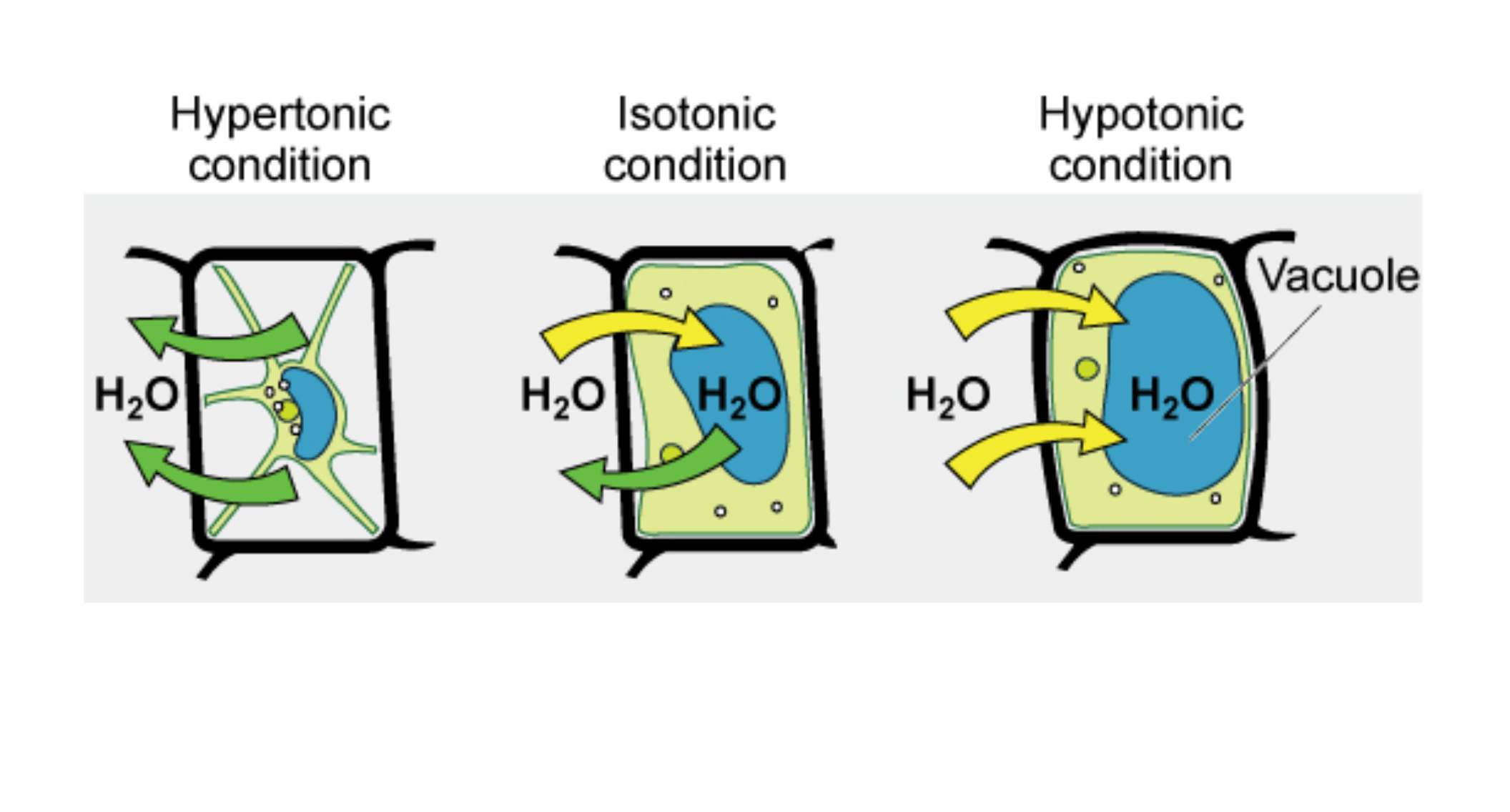
A hypertonic solution causes water to move out of the cell and the cell membrane tears away from the cell wall in a process called plasmolysis.
An isotonic solution does not result in any net movement of water in/out of the cell, however, a plant cell may become flaccid (wilted).
A hypotonic solution causes water to move into the cell. The cell wall limits the cell’s volume preventing it from bursting. However, the plant cells to become turgid (swollen and firm).
9
Multiple Choice
What type of solution should you put fresh flowers in to keep them fresh the longest?
Hypertonic- It causes plasmolysis, which causes the flowers to turgid.
Hypotonic- It causes the cell membrane to push on the cell wall, causing the flowers to stay turgid.
Isotonic- It causes the flowers to become flaccid.
Neutral solution- It will not cause any change in the flowers
10
Fill in the Blanks
Type answer...
11
Fill in the Blanks
Type answer...
12
Fill in the Blanks
Type answer...
13
Multiple Choice
What happens when a plant cell becomes flaccid?
The plant becomes stiff or turgid due to an increase in cell pressure.
There is more structure to the cells
The plant cells bursts
The plant becomes wilted because of a loss of cell pressure.
14
Poll
How are you feeling about this lesson?
Great! Easy stuff.
Eh. It's alright, but I probably need more practice.
Yikes. I kind of know what's going on, but not really.
Wait, I'm taking biology?!
Plant and Animal Cell Tonicity
Let's explore what happens to plant and animal cells in different solutions!
Show answer
Auto Play
Slide 1 / 14
SLIDE

Similar Resources on Wayground
11 questions
Inverse Trig Functions
Presentation
•
9th - 12th Grade
11 questions
Map Skills In History
Presentation
•
9th - 12th Grade
10 questions
Surface Area
Presentation
•
9th - 12th Grade
10 questions
Grammar and Punctuation Review #1
Presentation
•
9th - 12th Grade
14 questions
Carbon and Nitrogen Cycle
Presentation
•
9th - 12th Grade
9 questions
Logarithms
Presentation
•
9th - 12th Grade
11 questions
Teenager 5 Session 22: Pronunciation & Speaking
Presentation
•
KG
11 questions
Spanish-speaking countries
Presentation
•
9th - 12th Grade
Popular Resources on Wayground
20 questions
"What is the question asking??" Grades 3-5
Quiz
•
1st - 5th Grade
20 questions
“What is the question asking??” Grades 6-8
Quiz
•
6th - 8th Grade
10 questions
Fire Safety Quiz
Quiz
•
12th Grade
20 questions
Equivalent Fractions
Quiz
•
3rd Grade
34 questions
STAAR Review 6th - 8th grade Reading Part 1
Quiz
•
6th - 8th Grade
20 questions
“What is the question asking??” English I-II
Quiz
•
9th - 12th Grade
20 questions
Main Idea and Details
Quiz
•
5th Grade
47 questions
8th Grade Reading STAAR Ultimate Review!
Quiz
•
8th Grade
Discover more resources for Biology
24 questions
BIOLOGY STAAR REVIEW
Quiz
•
9th Grade
30 questions
Biology STAAR Review #3
Quiz
•
9th Grade
16 questions
AP Biology: Unit 1 Review (CED)
Quiz
•
9th - 12th Grade
50 questions
Biology EOC Review
Quiz
•
9th Grade
25 questions
photosynthesis and cellular respiration
Quiz
•
9th Grade
20 questions
AP Biology: Unit 3 Review (CED)
Quiz
•
9th - 12th Grade
20 questions
Enzymes
Quiz
•
9th Grade
20 questions
Food Chains and Food Webs
Quiz
•
7th - 12th Grade