
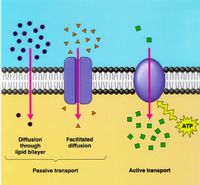
Cell Transport and Cellular Complexity Flashcard

Flashcard
•
Science
•
9th Grade
•
Practice Problem
•
Hard

KARYN HARVEY
FREE Resource
Student preview

20 questions
Show all answers
1.
FLASHCARD QUESTION
Front
Function of the cell membrane in maintaining homeostasis?
Back
Regulating the movement of substances in and out of the cell
Answer explanation
The cell membrane regulates the movement of substances in and out of the cell, which is crucial for maintaining homeostasis. The other options involve different cellular functions not directly related to homeostasis.
2.
FLASHCARD QUESTION
Front
What is the main difference between prokaryotic and eukaryotic cells?
Back
Eukaryotic cells have a nucleus, prokaryotic cells do not
Answer explanation
The main difference is that eukaryotic cells contain a nucleus, which houses their genetic material, while prokaryotic cells lack a nucleus and have their genetic material freely floating in the cell. Thus, the correct choice is that eukaryotic cells have a nucleus, prokaryotic cells do not.
3.
FLASHCARD QUESTION
Front
Which process requires energy input from the cell to move molecules across the cell membrane?
Back
Active transport
Answer explanation
Active transport is the process that requires energy input from the cell to move molecules against their concentration gradient, unlike diffusion, osmosis, and facilitated diffusion, which do not require energy.
4.
FLASHCARD QUESTION
Front
Which structure is found in eukaryotic cells but not in prokaryotic cells?
Back
Mitochondrion
Answer explanation
Mitochondria are organelles responsible for energy production and are found only in eukaryotic cells. Prokaryotic cells lack membrane-bound organelles, including mitochondria, while they do have ribosomes, cell walls, and plasma membranes.
5.
FLASHCARD QUESTION
Front
What is passive transport?
Back
Movement of molecules from high to low concentration without using energy
Answer explanation
Passive transport is the movement of molecules from high to low concentration without using energy. This process relies on the natural tendency of molecules to spread out, making it distinct from active transport, which requires energy.
6.
FLASHCARD QUESTION
Front
What is present in both prokaryotic and eukaryotic cells?
Back
Ribosomes
Answer explanation
Ribosomes are essential for protein synthesis and are found in both prokaryotic and eukaryotic cells. In contrast, nuclei, mitochondria, and chloroplasts are specific to eukaryotic cells.
7.
FLASHCARD QUESTION
Front
Which type of cellular transport is responsible for the movement of oxygen into cells?
Back
Diffusion
Answer explanation
Oxygen moves into cells primarily through diffusion, a passive transport process where molecules move from an area of higher concentration to an area of lower concentration, allowing oxygen to enter cells easily.
Access all questions and much more by creating a free account
Create resources
Host any resource
Get auto-graded reports

Continue with Google

Continue with Email

Continue with Classlink

Continue with Clever
or continue with

Microsoft
%20(1).png)
Apple

Others
Already have an account?
Similar Resources on Wayground

20 questions
Amplify Magnetic Fields Chapter 2 Review
Flashcard
•
8th Grade
12 questions
تمييز العدد 1
Flashcard
•
8th Grade
18 questions
THE MERCHANT OF VENICE ACT 1
Flashcard
•
10th Grade
12 questions
Fun Brain Riddles and Teasers Flashcard
Flashcard
•
8th Grade
17 questions
Physics Flashcard
Flashcard
•
9th Grade
17 questions
Westward Expansion Review
Flashcard
•
9th Grade
12 questions
Data Transmission
Flashcard
•
9th Grade
11 questions
Identify Parts of an Algebraic Expression and Evaluate
Flashcard
•
9th Grade
Popular Resources on Wayground
15 questions
Fractions on a Number Line

Quiz
•
3rd Grade
20 questions
Equivalent Fractions
Quiz
•
3rd Grade
25 questions
Multiplication Facts
Quiz
•
5th Grade
29 questions
Alg. 1 Section 5.1 Coordinate Plane
Quiz
•
9th Grade
22 questions
fractions
Quiz
•
3rd Grade
11 questions
FOREST Effective communication

Lesson
•
KG
20 questions
Main Idea and Details
Quiz
•
5th Grade
20 questions
Context Clues
Quiz
•
6th Grade
Discover more resources for Science
8 questions
Momentum and Collisions
Lesson
•
9th - 12th Grade
25 questions
Naming Ionic and Covalent Compounds
Quiz
•
9th Grade
10 questions
Exploring Weathering, Erosion, and Deposition Processes

Interactive video
•
6th - 10th Grade
10 questions
Cladogram Practice
Quiz
•
9th Grade
12 questions
The Respiratory System
Lesson
•
9th - 12th Grade
14 questions
Natural Selection and Adaptation
Lesson
•
9th - 12th Grade
10 questions
Exploring the Rock Cycle and Plate Tectonics
Interactive video
•
6th - 10th Grade
10 questions
calculating work
Quiz
•
9th Grade