

Geometry Review / Flashcard - 6th grade

Flashcard
•
Mathematics
•
6th Grade
•
Practice Problem
•
Easy

Eddie Coverson
Used 4+ times
FREE Resource
Student preview

20 questions
Show all answers
1.
FLASHCARD QUESTION
Front
The base and height of a parallelogram must be...

Back
perpendicular
Answer explanation
The base and height of a parallelogram must be perpendicular to each other. This ensures that the height is measured straight up from the base, allowing for accurate area calculation.
2.
FLASHCARD QUESTION
Front
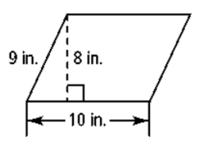
Find the area of the parallelogram.
Back
80
Answer explanation
The area of a parallelogram is calculated using the formula: Area = base × height. If the base is 10 and the height is 8, then Area = 10 × 8 = 80. Thus, the correct answer is 80.
3.
FLASHCARD QUESTION
Front
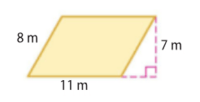
Area of the parallelogram?
Back
77 m2
Answer explanation
To find the area of a parallelogram, use the formula: Area = base × height. Given the dimensions, the calculation yields 77 m², making this the correct answer.
4.
FLASHCARD QUESTION
Front
How do you find the AREA of a TRIANGLE?
Back
base x height divided by 2
Answer explanation
To find the area of a triangle, use the formula: (base x height) divided by 2. This accounts for the triangle's shape, as it is half of a rectangle formed by the base and height.
5.
FLASHCARD QUESTION
Front
What is the area of this triangle?

Back
6 sq. cm.
Answer explanation
To find the area of a triangle, use the formula: Area = 1/2 * base * height. If the base is 4 cm and height is 3 cm, then Area = 1/2 * 4 * 3 = 6 sq. cm. Thus, the correct answer is 6 sq. cm.
6.
FLASHCARD QUESTION
Front
Find the area of the triangle.

Back
28 cm2
Answer explanation
To find the area of a triangle, use the formula: Area = 1/2 * base * height. Given the dimensions, the calculation yields 28 cm², making this the correct choice among the options.
7.
FLASHCARD QUESTION
Front
A flat "unfolded" representation of a prism or pyramid is called .......
Back
Net
Answer explanation
A flat "unfolded" representation of a prism or pyramid is called a "Net". It shows all the faces of the 3D shape laid out in 2D, making it easier to visualize the surface area and dimensions.


Access all questions and much more by creating a free account
Create resources
Host any resource
Get auto-graded reports

Continue with Google

Continue with Email

Continue with Classlink

Continue with Clever
or continue with

Microsoft
%20(1).png)
Apple

Others
Already have an account?
Similar Resources on Wayground

18 questions
Year 7 Ecosystems
Flashcard
•
6th - 7th Grade
15 questions
Flashcard review for TLE Quiz 1
Flashcard
•
6th - 8th Grade
8 questions
American Holidays
Flashcard
•
6th Grade
21 questions
Law Vocabulary
Flashcard
•
5th - 7th Grade
18 questions
Simplifying Fractions
Flashcard
•
4th Grade
15 questions
Types of Government
Flashcard
•
6th Grade
14 questions
The Canadian Charter of Rights and Freedoms
Flashcard
•
6th Grade
Popular Resources on Wayground
8 questions
Spartan Way - Classroom Responsible

Quiz
•
9th - 12th Grade
15 questions
Fractions on a Number Line
Quiz
•
3rd Grade
14 questions
Boundaries & Healthy Relationships

Lesson
•
6th - 8th Grade
20 questions
Equivalent Fractions
Quiz
•
3rd Grade
3 questions
Integrity and Your Health
Lesson
•
6th - 8th Grade
25 questions
Multiplication Facts
Quiz
•
5th Grade
9 questions
FOREST Perception
Lesson
•
KG
20 questions
Main Idea and Details
Quiz
•
5th Grade
Discover more resources for Mathematics
12 questions
Review: Surface Area of Rectangular and Triangular Prisms
Quiz
•
6th Grade
36 questions
6th Grade Math STAAR Review
Quiz
•
6th Grade
26 questions
Graphing Inequalities on a Number Line
Quiz
•
6th Grade
20 questions
Graphing Inequalities on a Number Line
Quiz
•
6th - 9th Grade
15 questions
Distributive Property & Review
Quiz
•
6th Grade
20 questions
Math Review
Quiz
•
6th Grade
15 questions
Mean, Median, Mode, and Range
Quiz
•
6th Grade
7 questions
Understanding Parallel, Intersecting, and Perpendicular Lines

Interactive video
•
1st - 6th Grade