
Covalent and Ionic Bonding

Flashcard
•
Science
•
8th Grade
•
Practice Problem
•
Easy

Patricia Neal
Used 1+ times
FREE Resource
Student preview

50 questions
Show all answers
1.
FLASHCARD QUESTION
Front
How many valence electrons does nitrogen have?
Back
5
Answer explanation
Nitrogen has 5 valence electrons, which are found in its outer shell. This is determined by its position in group 15 of the periodic table, where elements typically have 5 valence electrons.
2.
FLASHCARD QUESTION
Front
What can be generalized about covalent bonds?
Back
Electrons will be shared.
Answer explanation
Covalent bonds involve the sharing of electrons between atoms, allowing them to achieve stability. This distinguishes them from ionic bonds, where electrons are transferred. Therefore, the correct choice is that electrons will be shared.
3.
FLASHCARD QUESTION
Front
What is it called if there are three-pairs of electrons being shared?
Back
Triple bond
Answer explanation
When three pairs of electrons are shared between atoms, it forms a triple bond. This type of bond is stronger than a single or double bond, making 'Triple bond' the correct answer. Other options do not relate to electron sharing.
4.
FLASHCARD QUESTION
Front
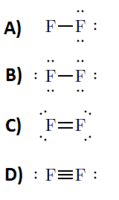
Correct Lewis dot structure for fluorine (F2)? Options: A, B, C, D
Back
B
Answer explanation
The correct Lewis dot structure for fluorine (F2) is choice B, which shows two fluorine atoms sharing a pair of electrons. Each fluorine atom has three lone pairs and one bond, representing the diatomic nature of F2.
5.
FLASHCARD QUESTION
Front
How many electrons should Carbon have around its Lewis dot structure?
Back
4
Answer explanation
Carbon has 4 valence electrons, which are represented in its Lewis dot structure. This allows it to form four covalent bonds with other atoms, making 4 the correct answer.
6.
FLASHCARD QUESTION
Front
What two types of atoms make a covalent bond?
Back
2 Nonmetals
Answer explanation
Covalent bonds form when two nonmetals share electrons. This sharing allows both atoms to achieve a full outer shell, which is a stable configuration. Therefore, the correct answer is 2 Nonmetals.
7.
FLASHCARD QUESTION
Front
How many electrons are shared in a double bond?
Back
4
Answer explanation
In a double bond, two pairs of electrons are shared between two atoms. This means a total of 4 electrons are involved in the bond, making the correct answer 4.
Access all questions and much more by creating a free account
Create resources
Host any resource
Get auto-graded reports

Continue with Google

Continue with Email

Continue with Classlink

Continue with Clever
or continue with

Microsoft
%20(1).png)
Apple

Others
Already have an account?
Similar Resources on Wayground

50 questions
B1.2 Proteins
Flashcard
•
9th - 12th Grade
31 questions
friends
Flashcard
•
10th Grade
30 questions
Making Use of energy
Flashcard
•
9th Grade
36 questions
Review for Exemplar 2a
Flashcard
•
8th Grade - University
50 questions
Nys Science Test Prep
Flashcard
•
6th - 8th Grade
50 questions
Physical Science Midterm Test
Flashcard
•
10th Grade
36 questions
Basic Chemistry Concepts
Flashcard
•
7th Grade
30 questions
Law of Conservation of Mass ( Beefy)
Flashcard
•
7th Grade
Popular Resources on Wayground
7 questions
History of Valentine's Day

Interactive video
•
4th Grade
15 questions
Fractions on a Number Line

Quiz
•
3rd Grade
20 questions
Equivalent Fractions
Quiz
•
3rd Grade
25 questions
Multiplication Facts
Quiz
•
5th Grade
22 questions
fractions
Quiz
•
3rd Grade
15 questions
Valentine's Day Trivia
Quiz
•
3rd Grade
20 questions
Main Idea and Details
Quiz
•
5th Grade
20 questions
Context Clues
Quiz
•
6th Grade
Discover more resources for Science
11 questions
Valentines Day
Quiz
•
6th - 8th Grade
25 questions
Valentine's Day Trivia
Quiz
•
8th Grade
20 questions
Cell Organelles and Functions
Quiz
•
6th - 8th Grade
8 questions
Newton's Second Law

Lesson
•
6th - 8th Grade
10 questions
Exploring the Rock Cycle: Types and Formation
Interactive video
•
6th - 8th Grade
10 questions
Carbon Cycle
Lesson
•
6th - 8th Grade
13 questions
Plate Tectonics and Earth's Structure
Lesson
•
6th - 8th Grade
20 questions
Heredity Punnett square review
Quiz
•
8th Grade