
Unit 3 - Rocks & Minerals Review

Flashcard
•
Geography
•
9th - 12th Grade
•
Practice Problem
•
Hard

Wayground Content
FREE Resource
Student preview

28 questions
Show all answers
1.
FLASHCARD QUESTION
Front
Igneous rocks are also known as
Back
Extrusive, Intrusive
Answer explanation
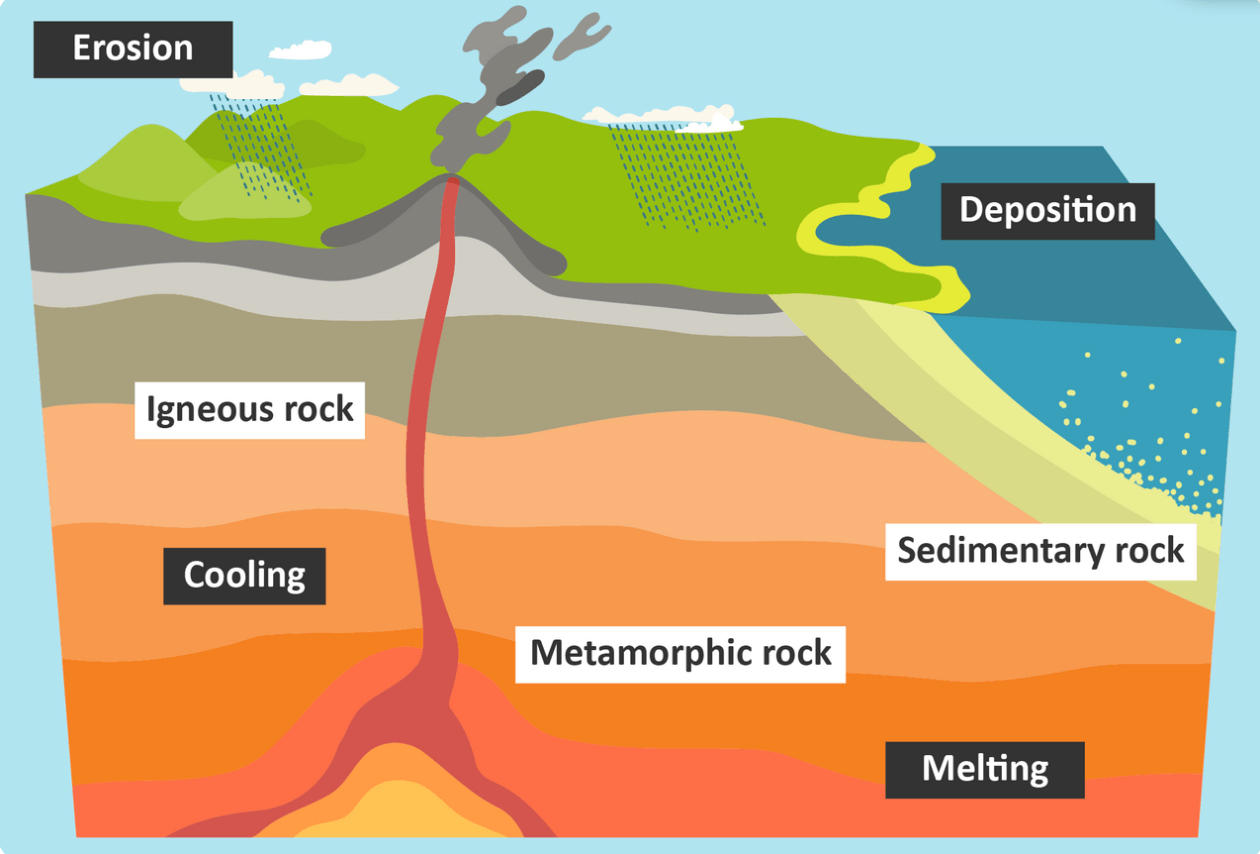
Igneous rocks are formed from the solidification of molten material. They are classified as extrusive when formed from lava on the surface and intrusive when formed from magma below the surface.
2.
FLASHCARD QUESTION
Front
Metamorphic Rocks are formed through the process of
Back
Heat and Pressure
Answer explanation
Metamorphic rocks are formed when existing rocks undergo changes due to intense heat and pressure, altering their mineral composition and structure. This process distinguishes them from other rock types.
3.
FLASHCARD QUESTION
Front
Minerals can be classified through: Composition, Texture, Crystal Size; Texture, Grain Size, Composition; Luster, Hardness, Streak; Luster, Color, Composition.
Back
Luster, Hardness, Streak
Answer explanation
Minerals can be classified by their physical properties. Luster, hardness, and streak are key characteristics used to identify and categorize minerals, making them essential for classification.
4.
FLASHCARD QUESTION
Front
Most igneous rocks are formed by which process?
Back
Melting and Solidification
Answer explanation
Most igneous rocks are formed through the process of melting and solidification. Magma from the Earth's interior cools and solidifies to create these rocks, distinguishing them from sedimentary and metamorphic rocks.
5.
FLASHCARD QUESTION
Front
The best evidence for determining cooling rate of an igneous rock during its solidification is provided by: the mineral composition, the crystal size of its minerals, the index fossils, faults in the rock.
Back
the crystal size of its minerals
Answer explanation
The crystal size of minerals in igneous rocks indicates the cooling rate; larger crystals form from slower cooling, while smaller crystals indicate rapid cooling. Thus, crystal size is the best evidence for solidification rates.
6.
FLASHCARD QUESTION
Front
The physical properties of minerals are determined by
Back
the internal arrangement of their atoms
Answer explanation
The physical properties of minerals, such as color and hardness, are influenced by the internal arrangement of their atoms. This atomic structure determines how minerals interact with light and other physical forces.
7.
FLASHCARD QUESTION
Front
This is a mineral property that shows how a mineral reflects light
Back
Luster
Answer explanation
Luster is the property of a mineral that describes how it reflects light. It is distinct from composition, fracture, and cleavage, which refer to different characteristics of minerals.


Access all questions and much more by creating a free account
Create resources
Host any resource
Get auto-graded reports

Continue with Google

Continue with Email

Continue with Classlink

Continue with Clever
or continue with

Microsoft
%20(1).png)
Apple

Others
Already have an account?



