
Law of superposition review

Flashcard
•
Science
•
7th - 8th Grade
•
Practice Problem
•
Hard

Wayground Content
FREE Resource
Student preview

15 questions
Show all answers
1.
FLASHCARD QUESTION
Front
What is the Law of Superposition?
Back
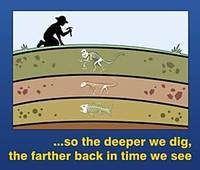
The Law of Superposition states that in any undisturbed sequence of rocks, the oldest layers are at the bottom and the youngest layers are at the top.
2.
FLASHCARD QUESTION
Front
What is an index fossil?
Back
An index fossil is a fossil that is used to define and identify a particular time period in the geological time scale. They are typically widespread and existed for a short duration.
3.
FLASHCARD QUESTION
Front
What are the two key traits of the best index fossils?
Back
The best index fossils are widespread geographically and have a short lifespan.
4.
FLASHCARD QUESTION
Front
Which fossil is considered the oldest among Trilobite, Ammonite, Crinoid, and Gastropod?
Back
Trilobite is considered the oldest fossil among these options.
5.
FLASHCARD QUESTION
Front
In the context of the Law of Superposition, what does 'youngest layer' refer to?
Back
The youngest layer refers to the topmost layer of rock in an undisturbed sequence, which is formed last.
6.
FLASHCARD QUESTION
Front
How can you determine the relative age of rock layers?
Back
You can determine the relative age of rock layers by using the Law of Superposition, examining the sequence of layers, and identifying index fossils.
7.
FLASHCARD QUESTION
Front
What is the significance of the order of rock layers?
Back
The order of rock layers helps geologists understand the history of the Earth, including the sequence of events and the relative ages of the rocks.
Access all questions and much more by creating a free account
Create resources
Host any resource
Get auto-graded reports

Continue with Google

Continue with Email

Continue with Classlink

Continue with Clever
or continue with

Microsoft
%20(1).png)
Apple

Others
Already have an account?



